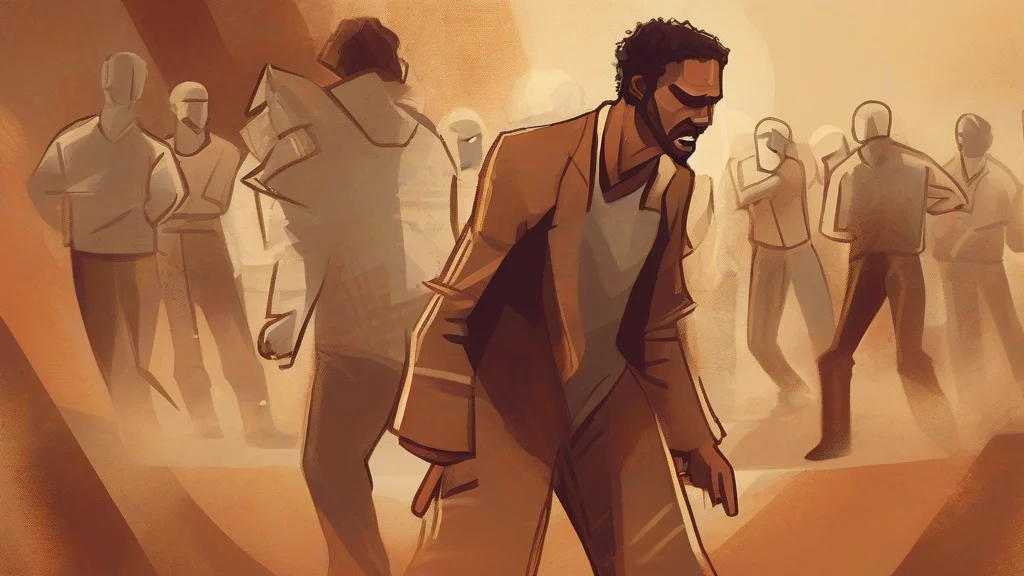
What does fracas mean?
A fracas is a noisy, disorderly fight or quarrel, especially one erupting in a public place and involving several people rather than a simple one-to-one argument. The word carries connotations of chaos and commotion — pushing, shouting, perhaps thrown drinks — but it is generally used with a tone of detached, almost amused disapproval rather than moral outrage, which is why journalists reach for it when describing disturbances at pubs, sporting events, or award ceremonies. It sits in the formal-to-neutral register: more polished than 'brawl' or 'scrap', more concrete than 'dispute'. The word entered English in the early seventeenth century from French, ultimately deriving from Italian 'far fracassa', meaning to make a loud crash, with roots in Latin 'frangere', to break. Its standard plural is 'fracases'. Knowing 'fracas' gives writers and speakers a precise, colourful term for exactly those chaotic public scuffles that other words handle less elegantly.
nounA noisy, disorderly fight or quarrel, typically one taking place in public and involving several people.
- A noisy, disorderly public fight or brawl involving several people.
"The award ceremony descended into a fracas when two rival supporters began shouting at each other."
"A fracas broke out among the fans shortly after the final whistle."
"Parliamentary proceedings were briefly suspended following a fracas in the lobby."
Pronounced /ˈfreɪkəsiːz/, with the stress shifting to the second syllable.
"Late-night bars have long been associated with drunken fracases."
Though it sounds like a French import, 'fracas' traces back through Italian to a Latin verb meaning to break — every fracas is, in a sense, something that got smashed.
Reviewed by Deb Chak, Editor. AI-assisted content curated by RJS Tech Solutions LLP.
Etymology of fracas
'Fracas' entered English in the early seventeenth century via French, which borrowed it from the Italian expression 'far fracassa', meaning to make a loud crash or disturbance; the Italian phrase itself derives from 'fracassare', to smash, built on Latin 'frangere', to break. This same Latin root gave rise to English words such as 'fragile', 'fraction', and 'frangible'. The plural is conventionally 'fracases', with stress shifting to the second syllable.
How fracas is actually used
'Fracas' is a somewhat formal or journalistic word — newspapers favour it for describing public disturbances because it sounds vivid yet slightly elevated. It usually implies more than two participants and often alcohol or crowds. The plural is conventionally 'fracases', pronounced with the stress on the second syllable (/ˈfreɪkəsiːz/).
Easily confused with fracas
A fracas is a noisy physical brawl, whereas a fiasco is a complete failure or disaster of an event or plan.