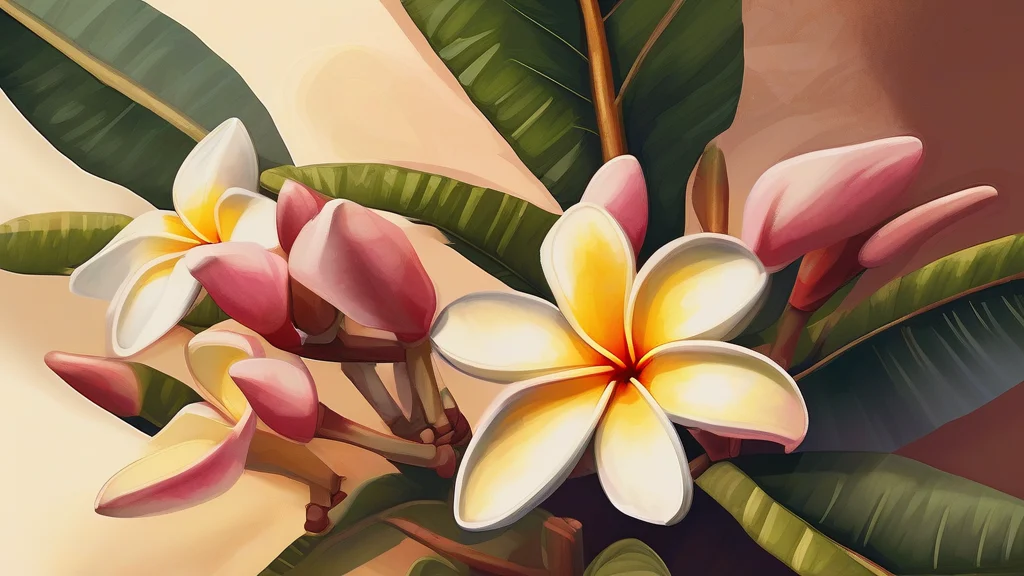
What does frangipani mean?
Frangipani is the common name for a group of fragrant tropical trees and shrubs of the genus Plumeria, prized throughout the world's warm regions for their clusters of waxy, sweetly scented flowers in white, yellow, pink, and red. Native to Central America and the Caribbean, the trees have become iconic in gardens across Southeast Asia, Australia, and the Pacific islands, where their blossoms are strung into leis, floated in bowls, and offered at temples — earning one species the nickname 'temple tree.' The name also attaches to a style of heavy floral perfume first associated with the blossom. Curiously, the word began as an Italian family name, and its other culinary offshoot, frangipane, names an almond pastry cream entirely unrelated to the flower. Today, saying 'frangipani' evokes tropical warmth, heady evening fragrance, and island hospitality, making it as much a symbol of place as a name for a plant.
nounA fragrant tropical tree or shrub of the genus Plumeria, native to Central America and the Caribbean, bearing clusters of waxy white, yellow, pink, or red flowers widely used in leis and perfumery; also, a perfume originally scented with or imitating this blossom.
- A fragrant tropical tree or shrub of the genus Plumeria, cultivated throughout warm regions for its showy, sweetly scented flowers.
- A perfume with a heavy floral scent, originally made from or modelled on the frangipani blossom.
"The courtyard was shaded by a frangipani whose fallen blossoms perfumed the entire garden."
"Visitors to Hawaii are greeted with leis woven from frangipani blossoms."
"She wore a classic frangipani perfume that recalled her travels in Bali."
The standard plural adds -s; 'frangipani' is occasionally treated as a plural noun in Australian usage, but 'frangipanis' is unambiguous.
"Several frangipanis lined the driveway, each a different colour."
The frangipani flower smells strongest at night — deliberately — to attract sphinx moths that pollinate it, even though those moths often get no nectar reward.
Reviewed by Deb Chak, Editor. AI-assisted content curated by RJS Tech Solutions LLP.
Etymology of frangipani
The word derives from the Italian surname Frangipani (also Frangepan), borne by a Roman noble family, and entered English in the 16th–17th century when a scented preparation or perfume was named in honour of Marquis Muzio Frangipani, who reputedly invented a bitter-almond-scented glove perfume. The botanical name was later applied by European naturalists to the Plumeria tree because its fragrance resembled that perfume. The closely related culinary term frangipane, denoting an almond custard filling, traces back to the same family name.
How frangipani is actually used
In everyday use, 'frangipani' almost always refers to the plant, especially in Australia, Southeast Asia, and the Pacific, where it is a familiar garden tree; the older perfume sense survives mainly in historical and cosmetics contexts. In botanical writing the equivalent genus name Plumeria is preferred. Both the final vowel and the middle consonant vary between speakers, so pronunciations differ noticeably between British and American sources.
Easily confused with frangipani
Frangipane is an almond-flavoured pastry cream or filling used in desserts, whereas frangipani is a tropical flowering tree (or its scent); the two names share an origin but refer to entirely different things.
Plumeria is simply the botanical genus name for the same plant commonly called frangipani, so the terms overlap rather than conflict.