What does frayed mean?
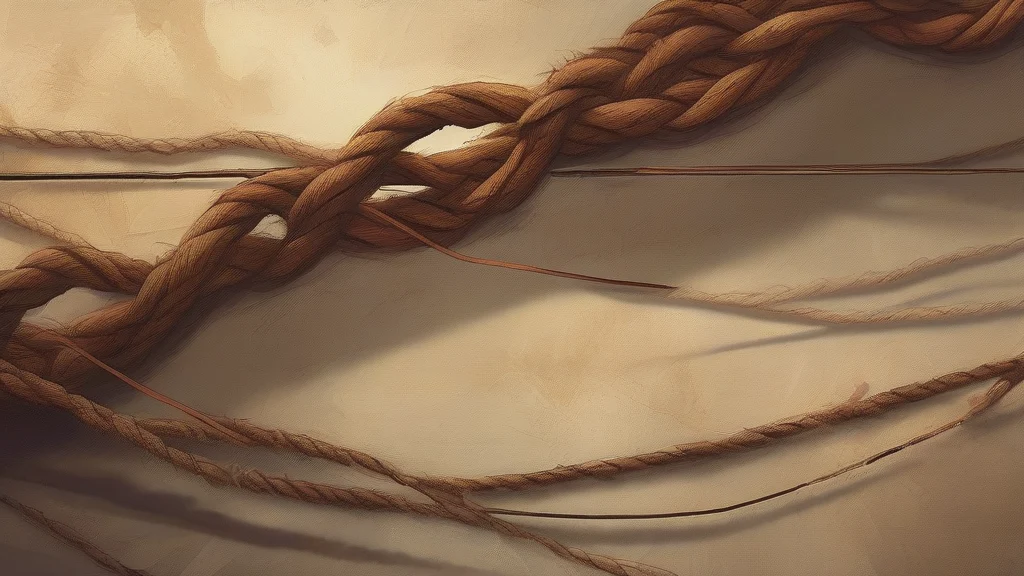
Frayed describes material — typically cloth, rope, or cable — that has been worn or rubbed until its edges unravel and loose threads hang free. A frayed sleeve, a frayed hem, or a frayed mooring line shows the physical damage caused by repeated rubbing or use. Beyond textiles, the word has become one of English's most familiar metaphors for human strain: frayed nerves, frayed tempers, and frayed relationships all evoke the image of something rubbed thin and close to coming apart. This dual life gives the word unusual range, letting writers move naturally between the literal and the emotional. Frayed is also the past participle of the verb 'to fray', which means to wear away by rubbing. Its imagery is inherently negative — damage, weariness, deterioration at the edges — making it a precise and evocative choice whenever something, whether fabric or patience, is nearing the point of unravelling.
Worn away or unravelling at the edges; (of nerves or tempers) strained by prolonged stress.
"The flag's frayed corners flapped in the wind."
Often used figuratively in phrases such as 'frayed nerves' and 'frayed tempers'.
Past form of the verb 'to fray': having been worn away by rubbing so that threads loosen or separate.
"The rope had frayed where it scraped against the dock."
As a participle it typically appears in completed-action contexts: 'the cuff had frayed'.
Every time you say your nerves are 'frayed', you're comparing your mind to a rope rubbed thin — a metaphor borrowed straight from centuries of wearing cloth and cord.
Reviewed by Deb Chak, Editor. AI-assisted content curated by RJS Tech Solutions LLP.
Etymology of frayed
Frayed comes from the verb 'to fray', meaning to wear away by rubbing, which entered English from Old French 'freier' or 'fraier' ('to rub'), ultimately deriving from the Latin verb 'fricare', meaning to rub or churn. This same Latin root gave English 'friction'. The noun 'fray' meaning a brawl or skirmish is generally traced to a different source, connected with 'affray', so the fighting sense should not be confused with the rubbing sense behind frayed.
Related word forms
How frayed is actually used
Frayed functions chiefly as an adjective but is also the past participle of the verb 'to fray'. Its figurative sense (frayed nerves, frayed tempers) is extremely common in journalism and everyday speech and carries a connotation of exhaustion rather than anger itself. The word suits both formal and informal registers without difficulty.
Easily confused with frayed
Afraid means feeling fear, while frayed describes physical unravelling or, figuratively, strained nerves — 'I'm afraid' expresses fear, whereas 'my nerves are frayed' describes exhaustion under stress.