What does freewheeling mean?
Freewheeling describes a way of acting or living that is relaxed, spontaneous, and unconstrained by convention. A freewheeling discussion wanders happily off-script; a freewheeling lifestyle embraces improvisation over planning; a freewheeling entrepreneur takes bold risks without fussing over rules. The word borrows its imagery from mechanics: on a bicycle fitted with a freewheel, the rear wheel spins freely ahead of the pedals, letting the rider coast without effort. By the early twentieth century this mechanical idea had become figurative, so that to be freewheeling suggested gliding through life unencumbered by resistance or restraint. The adjective is common in journalism and everyday speech, especially in phrases like 'a freewheeling style' or 'freewheeling negotiations'. Its connotations are mostly positive — vitality, openness, independence — though critics may use it to suggest recklessness or insufficient discipline. Related forms include the verb freewheel and the noun freewheeler.
Carefree, spontaneous, and unconstrained by rules or conventions.
"The documentary captures the band's freewheeling early years, when no two performances were alike."
Almost always used attributively ('a freewheeling attitude') or predicatively ('his style is freewheeling').
The action or state of freewheeling; informal use referring to a freewheeling manner of behaviour.
"The startup grew up in an era of entrepreneurial freewheeling, before regulations tightened."
As a noun it is relatively uncommon and usually appears in the gerund form 'the freewheeling' of a period or activity.
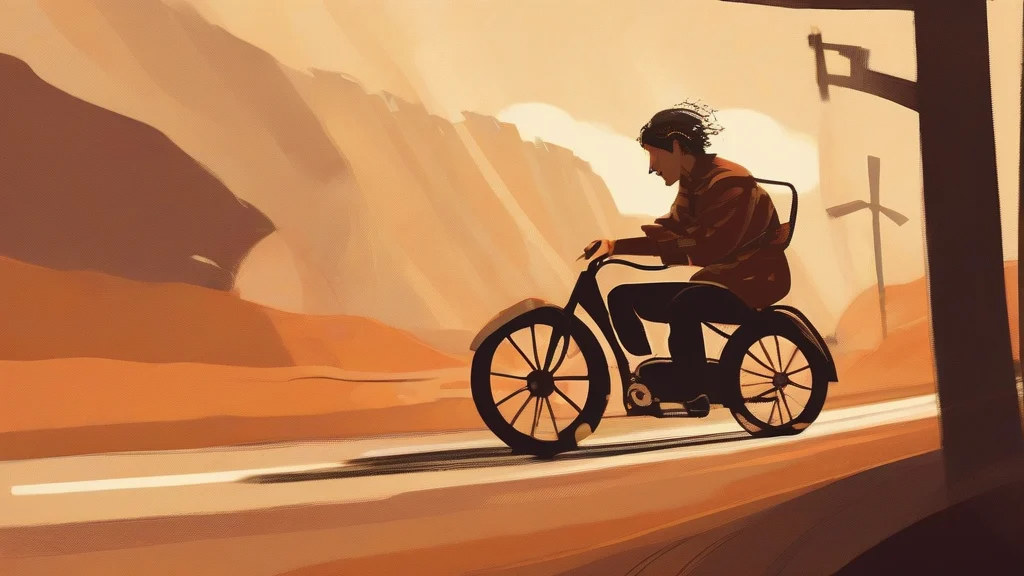
Before it described free-spirited people, freewheeling literally meant coasting on a bike without pedalling — the wheels do all the work while you just ride along.
Reviewed by Deb Chak, Editor. AI-assisted content curated by RJS Tech Solutions LLP.
Etymology of freewheeling
Freewheeling originates from the mechanical term 'freewheel', which emerged in late nineteenth-century English to describe a hub device allowing a wheel to turn independently of the drive mechanism. As cycling spread in the early twentieth century, the phrase was extended figuratively to people and behaviour that seemed to coast along effortlessly and unconventionally. It is thus an English compound formation from 'free' plus 'wheel', rather than a borrowing from another language; cognates are essentially other compounds built from the same elements, such as 'freewheel' itself and the agentive noun 'freewheeler'.
Related word forms
How freewheeling is actually used
Freewheeling carries a broadly positive, sometimes romantic connotation of freedom and spontaneity, though it can imply a lack of rigour in serious contexts such as finance or politics. It functions almost exclusively as an attributive or predicate adjective; the noun form 'freewheeler' names a person who lives this way.
Easily confused with freewheeling
Freewheel is the mechanical device (or the verb describing coasting on it), while freewheeling describes a person or style of behaviour that is carefree and unrestrained.