
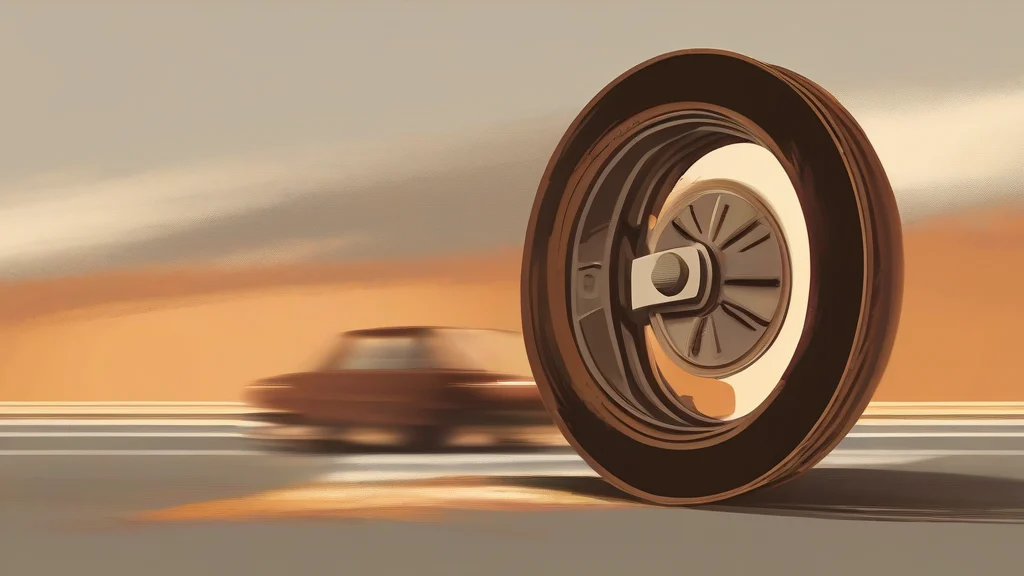
What does wheel mean?
A wheel is a circular part that turns around an axle, most commonly one of the components that allows a vehicle or machine to move. In everyday language, it can refer specifically to a vehicle’s steering wheel, but it also applies to rotating disks, rollers, gears, and parts of larger mechanisms. Wheel can be used as a verb: to wheel something means to rotate or turn it, while to wheel somewhere means to move in a curved direction. The word also has figurative uses, including a person with influence and the rotating forces associated with fortune or large systems. Its imagery is highly familiar, yet it carries a sense of movement, control, and cyclical change. The word is understood throughout Britain and the United States, with little regional difference. It is especially useful for discussing machinery, transport, steering, turning motion, and systems in which people feel caught up in events beyond their direct control.
A circular component that rotates around an axle, especially one supporting a vehicle or forming part of a machine.
"A bicycle wheel wobbled after the tire lost some air."
The word can also refer to a steering wheel, a rotating machine part, a wheel-like arrangement, or, informally, a powerful person.
To turn or rotate something, especially around an axis, or to move in a curved or circular course.
"The operator wheeled the heavy container into position."
The verb is neutral in register and is commonly used with vehicles, machinery, or objects that are being turned.
The plural is used for multiple physical wheels or rotating components and also in figurative expressions involving systems, forces, or circumstances.
"The wheels of the machine were checked before the demonstration began."
The wheel is one of civilization’s oldest machines: long before steering wheels, people followed the turning motion of a potter’s wheel.
Reviewed by Deb Chak, Editor. AI-assisted content curated by RJS Tech Solutions LLP.
Where does wheel come from?
The English word descends from Old English hwēol, meaning a wheel or the wheel of a chariot, and ultimately from a Proto-Germanic form associated with turning and circular motion. Its deeper Indo-European ancestry is connected with forms referring to wheels and rotation, including Sanskrit cakrá, meaning “wheel,” “disc,” or “circle.” English whorl and whirl developed from related Germanic roots and preserve the same association with turning.
Related word forms
How wheel is actually used
The noun can also refer informally to an influential or powerful person, although this use is more common in older or conversational English. The verb is formal to neutral and is often associated with steering, rotating, or moving in an arc.
Easily confused with wheel
A wheel is a physical circular component that rotates around an axle, whereas a whirl is the action or sensation of rapid spinning.