
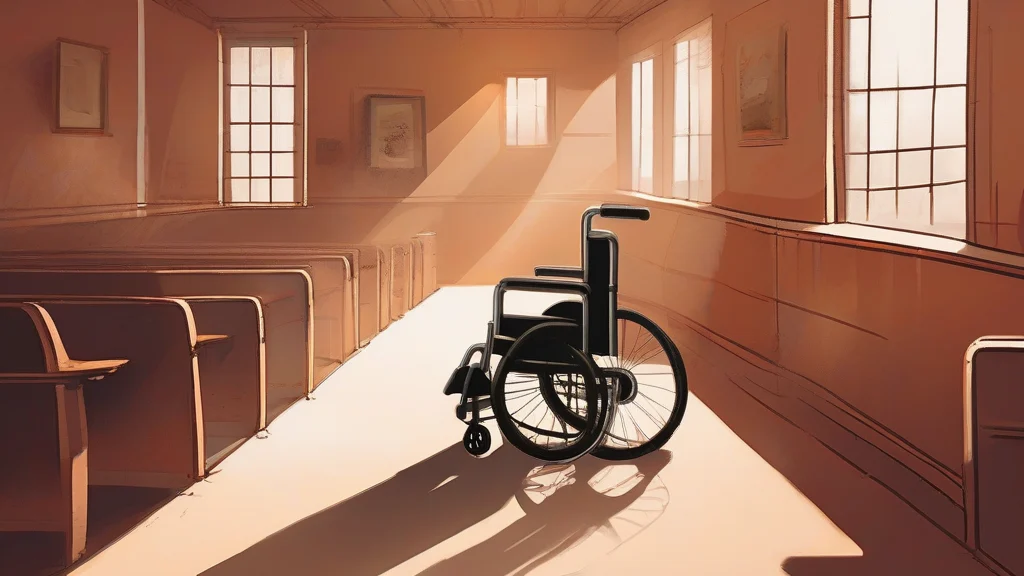
What does wheelchair mean?
A wheelchair is a mobile seating device consisting of a chair, wheels, and often brakes or controls. It allows a person who cannot walk, or who has difficulty walking, to move independently and participate in everyday activities. Manual wheelchairs are propelled by the user or an attendant, while powered or electric wheelchairs use a motor. The term can refer both to the chair itself and, by extension, to the broader system of equipment, buildings, transport, and services that support wheelchair users. In contemporary usage, “wheelchair user” is a respectful and common expression. Wheelchairs also carry broader social significance because they are closely associated with disability access, inclusion, and the principle that disabled people should have the same opportunities to travel, work, study, and take part in public life as everyone else.
nounA chair fitted with wheels that provides mobility to a person who cannot walk or has difficulty walking. It may be pushed by the user or an attendant, or powered by a motor.
- A chair mounted on wheels, designed to give a person mobility when walking is difficult, impossible, or unsafe.
"She used a manual wheelchair to cross the park independently."
"The building was renovated with a wheelchair ramp and an accessible entrance."
"He maneuvered his powered wheelchair through the busy conference hall."
The regular plural is “wheelchairs”; singular “wheelchair” is used before a noun, as in “a wheelchair ramp.”
"The center keeps several wheelchairs available for visitors who need them."
Two ordinary words—wheel and chair—combine to name a device that can transform everyday movement into independence.
Reviewed by Deb Chak, Editor. AI-assisted content curated by RJS Tech Solutions LLP.
Etymology of wheelchair
“Wheelchair” is an English compound formed from “wheel” and “chair,” both of which were established words before the compound came into general use. “Wheel” descends from Old English hwēol, while “chair” entered Middle English from Old French chaire, from Latin cathedra, ultimately from Greek kathedra. The compound therefore combines an Old English word with a chair term that has Latin and Greek ancestry.
How wheelchair is actually used
“Wheelchair user” is generally regarded as a respectful, natural description. Expressions such as “wheelchair-bound” and “confined to a wheelchair” may sound dated or unnecessarily limiting. In public and institutional language, accessibility and the user's autonomy are commonly emphasized.
Easily confused with wheelchair
“Wheel chair” is a traditional two-word spelling of the same noun, while “wheelchair” is the standard modern spelling.