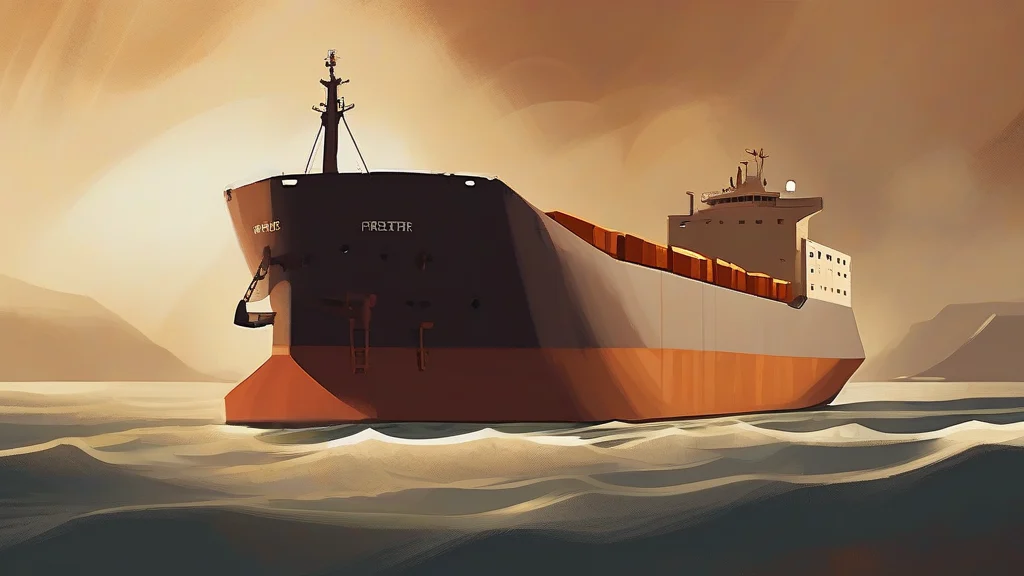
What does freighter mean?
A freighter is a ship — or, in modern usage, sometimes an aircraft — built and operated chiefly for hauling commercial cargo rather than passengers. Freighters form the backbone of global trade, moving containers, bulk commodities such as grain and ore, oil, vehicles, and general merchandise across oceans and continents. The name comes from 'freight', the charge paid for transporting goods, which itself derives from older Germanic terms for loading a vessel. In everyday speech the term usually evokes the vast container ships and bulk carriers that dominate maritime commerce, while airlines reserve it for cargo planes, often converted from passenger aircraft. Plain-spoken and functional, the word conveys scale and industry: a single large freighter can carry tens of thousands of tons of goods, making it one of the quiet workhorses of the modern economy and a fitting emblem of international commerce.
A ship designed or used for transporting goods and commercial cargo rather than passengers.
"The ore freighter departed Port Hedland bound for a steel mill in East Asia."
This is the dominant sense; 'freighter' in casual conversation almost always means a cargo ship.
An aircraft configured and used for carrying cargo rather than passengers.
"Boeing still builds the 747 freighter for air cargo operators worldwide."
Common mainly within aviation, shipping-industry, and military-logistics contexts.
Standard plural; no irregularities.
"Three freighters waited offshore for berths to open at the container terminal."
The word 'freighter' descends from an old Germanic term meaning to load or burden a boat — the cargo came first, and the word for the vessel followed.
Reviewed by Deb Chak, Editor. AI-assisted content curated by RJS Tech Solutions LLP.
Etymology of freighter
The noun 'freighter' derives from 'freight', meaning cargo or payment for its carriage, which traces back through Middle English 'freight' (probably influenced by Dutch 'vracht') to Old English 'fracht' and ultimately Germanic roots denoting a load or burden placed on a vessel. The related Old English word 'fraught', meaning loaded or laden, shares this ancestry, as does the legal term 'affreightment', the contract for hiring a ship's cargo space. As dedicated cargo vessels became common in the age of steam and later with cargo aircraft, 'freighter' settled into its modern sense as the name for the carrying craft itself.
How freighter is actually used
'Freighter' is a neutral, practical term common in shipping, trade, and logistics contexts; it carries no strong connotation of formality. In casual use it most often refers to ocean-going vessels, though the aviation industry applies the same word to cargo aircraft. The plural is straightforwardly 'freighters'.
Easily confused with freighter
Freight refers to the goods or cargo being transported, whereas a freighter is the ship or aircraft that carries them.