
What does liner mean?
liner most often denotes a passenger or cargo ship that follows a regular long-distance route, often carrying travelers across an ocean or between major ports. In this sense, it suggests both a distinctive mode of transport and a service organized around scheduled departures. The word also has a practical meaning: an insert, sheet, or other object placed inside a container, drawer, case, or piece of furniture to form a protective or decorative inner layer. That meaning explains the verb, which is uncommon but means to fit something with a lining or inner covering. Although liner can sound grandly nautical today, its history is connected to the practical vocabulary of arranging, covering, and protecting things. It remains useful because it can refer both to an everyday inner layer and to the imposing ships traditionally associated with long-distance travel.
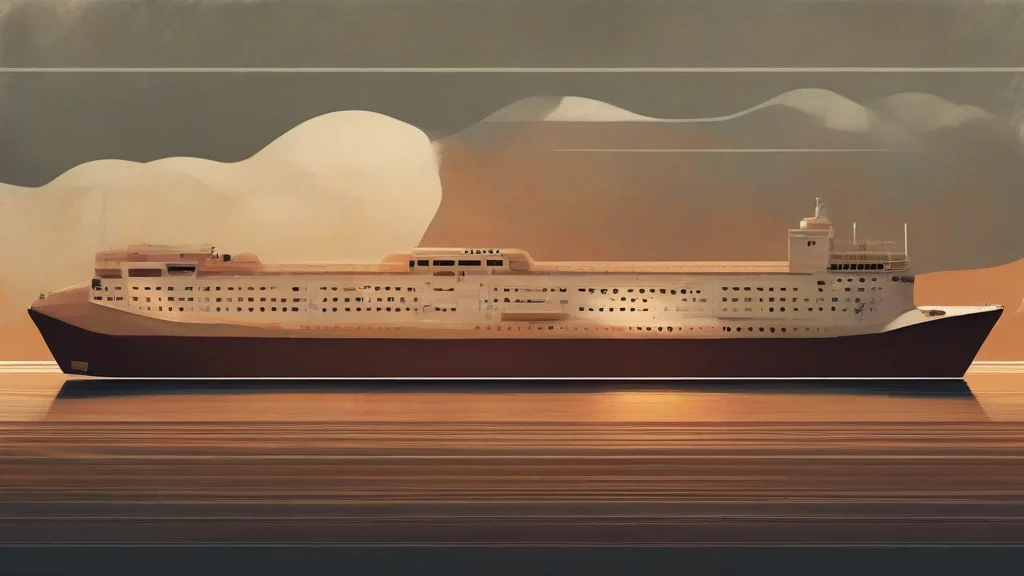
As a noun, a liner is a passenger or cargo ship operating on a regular long-distance route. It can also mean an inner covering or insert fitted inside a container, drawer, or similar object.
"The company operates a weekly liner service between the two countries."
The ship sense is less frequent in contemporary speech than it was during the era of regular transatlantic and colonial shipping services.
To fit or cover something with an inner layer, especially as the work of an upholsterer, cabinet maker, or other craftsman.
"The upholsterer liners the suitcase with padded fabric."
This use is relatively uncommon; line is generally preferred in everyday speech.
The plural refers to multiple ships in the maritime sense or multiple inner coverings or inserts in the practical sense.
"Several liners were expected to arrive at the port before noon."
The word travelled from the humble idea of an inner covering to the grand ships that carried people across oceans—a reminder that everyday words can end up on a luxury deck.
Reviewed by Deb Chak, Editor. AI-assisted content curated by RJS Tech Solutions LLP.
Where does liner come from?
The word descends from line, whose deeper root is the Latin linum, meaning flax. Latin linea originally referred to a line of flax or thread and developed into the English sense of an arrangement or row, while linen preserves the flax connection. The ship meaning emerged in the 19th century for vessels operating on regular long-distance routes, while linear and lineage descend through the Latin word linea. The earlier sense of a person or thing that forms a lining led to the modern inner-covering meaning.
Related word forms
How liner is actually used
The ship sense is standard in British and American English, although it is less frequently encountered today than in the era of regular ocean and rail services. As a verb, liner is relatively uncommon; line is usually the more natural choice in general speech.
Easily confused with liner
A linter removes lint, whereas a liner supplies an inner covering or refers to a passenger or cargo ship.