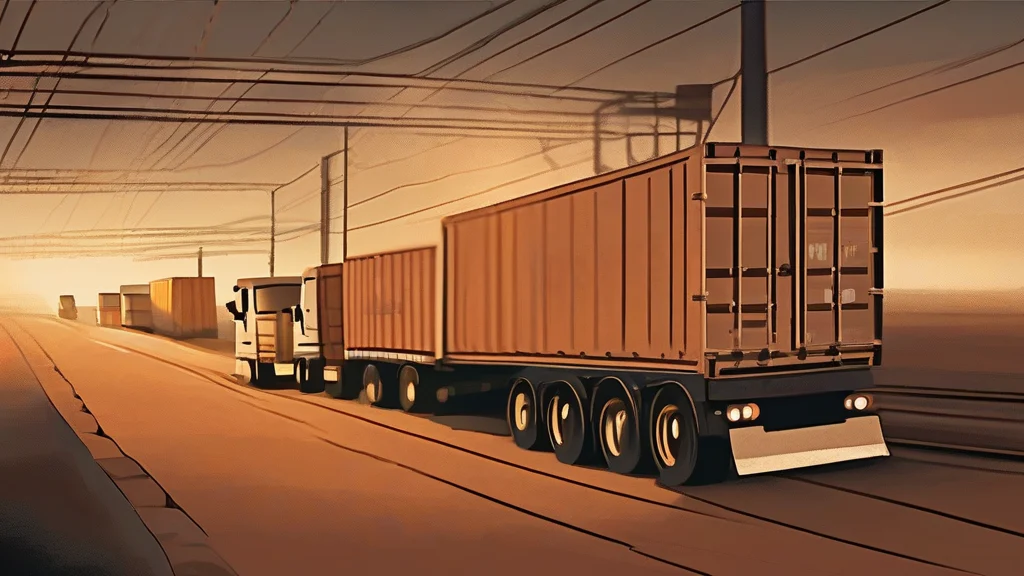
What does freighting mean?
Freighting denotes the business and activity of transporting goods commercially, whether by sea, rail, road, or air. It functions both as a noun naming the trade itself — as when a company is described as being 'in the freighting business' — and as the gerund of the verb 'freight', which covers the loading and conveyance of cargo for payment. The word carries a practical, industrial register: it belongs to the vocabulary of logistics, shipping schedules, tariffs, and trade reports rather than casual chat, and it evokes images of dockyards, freight trains, and long-haul lorries. Its history is deeply mercantile: it derives from 'freight', a term adopted into medieval English from Dutch and Low German sources concerned with ships' cargoes, making it a linguistic relic of northern European maritime commerce. Although the simpler noun 'freight' dominates modern usage, 'freighting' remains useful whenever writers want to foreground the process and industry of moving goods rather than the goods themselves, and it pairs naturally with modifiers specifying the mode of transport involved.
The business, trade, or activity of transporting goods commercially, especially in bulk.
"Railway freighting dominated inland cargo transport throughout the nineteenth century."
Usually treated as an uncountable activity; it most often appears with a modifier indicating the mode of transport.
The act of loading or conveying cargo for hire; the -ing form of the verb 'freight'.
"They were freighting timber down the coast when the storm struck."
'Freighting' names an activity or industry and is used as an uncountable noun; it has no established plural form.
"Coastal freighting declined sharply after the railways spread."
Freight and fraught are close cousins: both sailed into English from medieval Dutch traders' word for a ship's cargo — so every 'freighting' shipment carries an echo of its more anxious relative.
Reviewed by Deb Chak, Editor. AI-assisted content curated by RJS Tech Solutions LLP.
Etymology of freighting
'Freighting' derives from 'freight', which entered English in the Middle English period from Middle Dutch or Frisian forms such as 'vracht', meaning a ship's cargo or its carriage charge. The same Germanic root gave rise to the adjective 'fraught', originally denoting a ship loaded with cargo before evolving its modern emotional sense. As commerce expanded, the noun 'freight' naturally yielded the activity-name 'freighting' and derivatives such as 'freighter' and 'freightage'.
Related word forms
How freighting is actually used
Largely a commercial and industry-register term, appearing most often in logistics, shipping, and trade contexts rather than everyday conversation. In modern usage the bare noun 'freight' is far more frequent, and 'freighting' typically surfaces when the emphasis is on the activity or industry rather than the cargo itself.
Easily confused with freighting
'Freight' refers to the goods or cargo being transported (or, as a verb, to the act of transporting them), while 'freighting' names the overall activity or business of carrying such goods.
'Frighting' means causing fear or alarm, whereas 'freighting' concerns the commercial transport of goods — they differ by only a single letter.