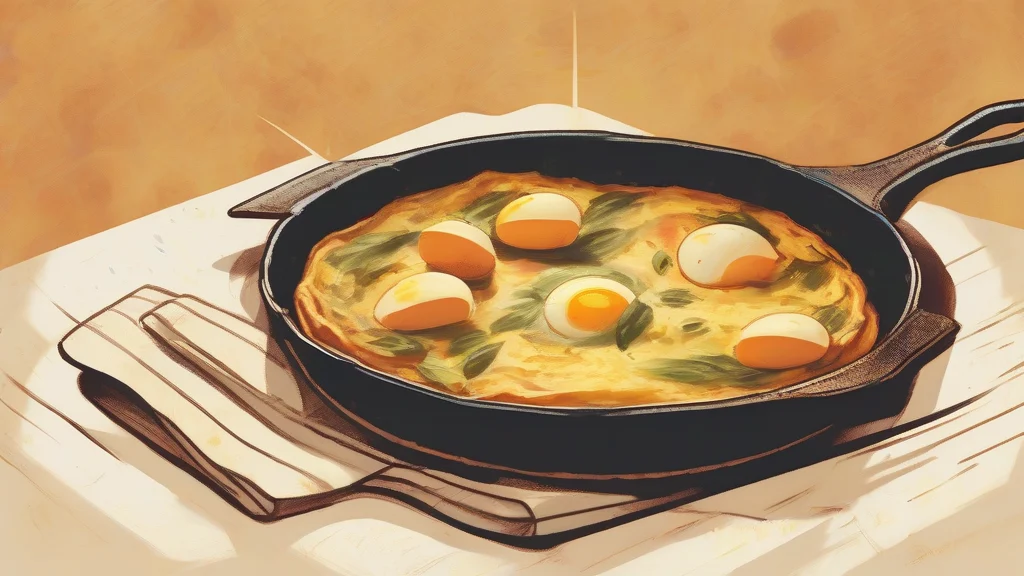
What does frittata mean?
A frittata is an Italian-style open-faced omelette made by cooking beaten eggs slowly in a pan, usually combined with vegetables, cheese, potatoes, cured meat, or herbs. Unlike a French omelette, which is folded around its filling and served soft, a frittata is left flat, often finished in the oven or under a broiler, and cut into wedges to serve. It may be eaten hot, warm, or at room temperature, which has long made it popular for picnics, buffets, and packed lunches in Italy. In English, the word was borrowed directly from Italian in the twentieth century as Mediterranean cooking entered mainstream Anglo-American kitchens. Today it carries a relaxed, resourceful connotation — a frittata is widely regarded as an economical way to transform leftovers into something satisfying, making it a staple phrase in recipe columns, cookbooks, and café menus alike.
nounAn Italian dish of beaten eggs cooked slowly in a pan, typically filled with vegetables, cheese, or meat, and served flat rather than folded like an omelette.
- An open-faced Italian omelette made with eggs and fillings such as vegetables, cheese, or meat, cooked gently and served flat, often cut into wedges.
"She made a courgette and goat's cheese frittata for the brunch table."
"A spinach and ricotta frittata makes an easy supper from whatever is left in the fridge."
"The café serves thick slabs of potato and rosemary frittata alongside its morning coffee."
English uses the regular plural 'frittatas'; the original Italian plural is 'frittate', occasionally retained in Italian-influenced food writing.
"Mini frittatas baked in muffin tins are a favourite at brunches."
In Italy, a thick wedge of room-temperature frittata is classic picnic food — it travels so well that soldiers once carried it in their packs.
Reviewed by Deb Chak, Editor. AI-assisted content curated by RJS Tech Solutions LLP.
Etymology of frittata
Frittata comes from Italian, where it literally means 'fried', derived from fritto ('fried') and ultimately from the Latin verb frigere, 'to fry'. It entered English usage in the mid-twentieth century as Italian cuisine gained popularity abroad. The same Latin root gives English 'fry' and 'fritter', making them close relatives of the word.
How frittata is actually used
Borrowed directly from Italian, the word retains its Italian pronunciation and plural form in English usage. It carries a casual, wholesome connotation and appears mostly in culinary contexts — recipes, menus, and food writing — rather than everyday conversation. The word is fully naturalized in both British and American cooking vocabulary.
Easily confused with frittata
An omelette is cooked quickly over high heat and usually folded around its filling, whereas a frittata is cooked more slowly and served open-faced, often finished under the broiler or baked.
A quiche contains a pastry crust and custard-rich filling baked in the oven, while a frittata is crustless and cooked primarily on the stovetop.