
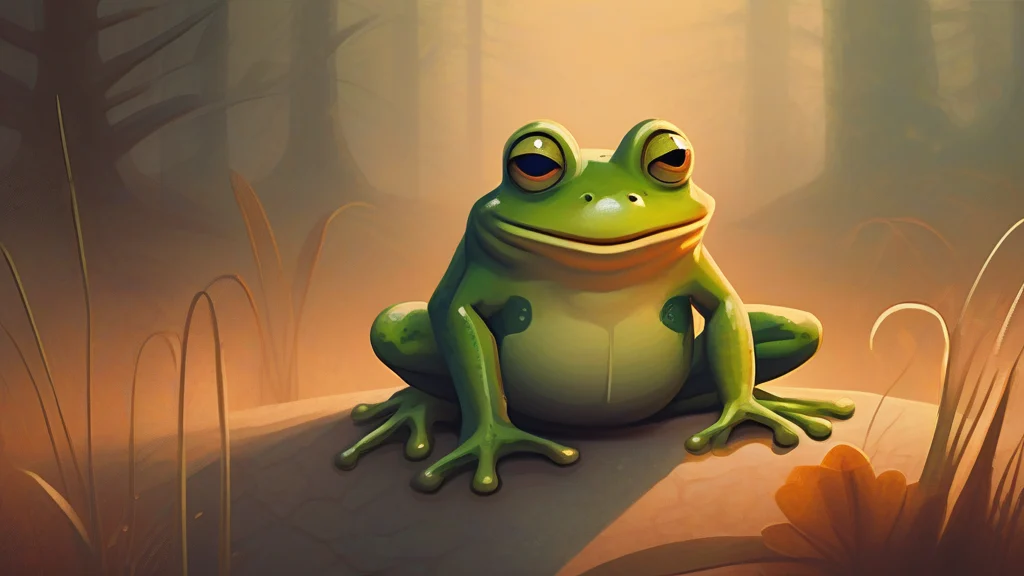
What does froggier mean?
Froggier is the comparative form of the adjective froggy, a familiar and often affectionate word for something resembling or associated with a frog. It means more frog-like and is commonly used to describe voices, accents, movements, appearances, or other qualities that seem characteristically froggy. For example, a performer might use a froggier voice, while a child might move in a froggier, more playful way. The word generally has a light, humorous, or endearing tone rather than a formal or technical one, although it can describe a comparison without necessarily being funny. Its imagery is strongly connected with frogs, ponds, short hopping movements, bulging eyes, and croaking calls. The spelling with two gs is standard, although frogier is also used. In careful usage, a comparative ending does not take another more: say even froggier or much froggier rather than more froggier.
adjectiveThe comparative form of froggy: more frog-like or more characteristic of a frog.
- More frog-like or more characteristic of a frog.
"The child spoke in a froggier voice when imitating the pond's inhabitants."
"The comedian performed in an increasingly froggier voice."
"As the rain intensified, the pond's landscape took on a froggier appearance."
Froggier turns the affectionate nickname froggy into the go-to word for something even more frog-like.
Reviewed by Deb Chak, Editor. AI-assisted content curated by RJS Tech Solutions LLP.
Etymology of froggier
Froggy is an English formation based on frog with the familiar suffix -y, giving the word an affectionate and playful character. Adding the comparative suffix -er produces froggier; the final y becomes i, and the doubled g preserves the consonant sound. The vocabulary is Germanic in origin, but the particular formation froggy is an English playful derivative rather than a shared inherited form.
Related word forms
How froggier is actually used
Usually informal, playful, and often affectionate. It is especially natural when describing a voice, accent, movement, or appearance, and the intensifiers much, even, and rather are common: much froggier, even froggier, and rather froggier.
Easily confused with froggier
Froggier means more frog-like, whereas fogier means more foggy, referring to cloud or mist.