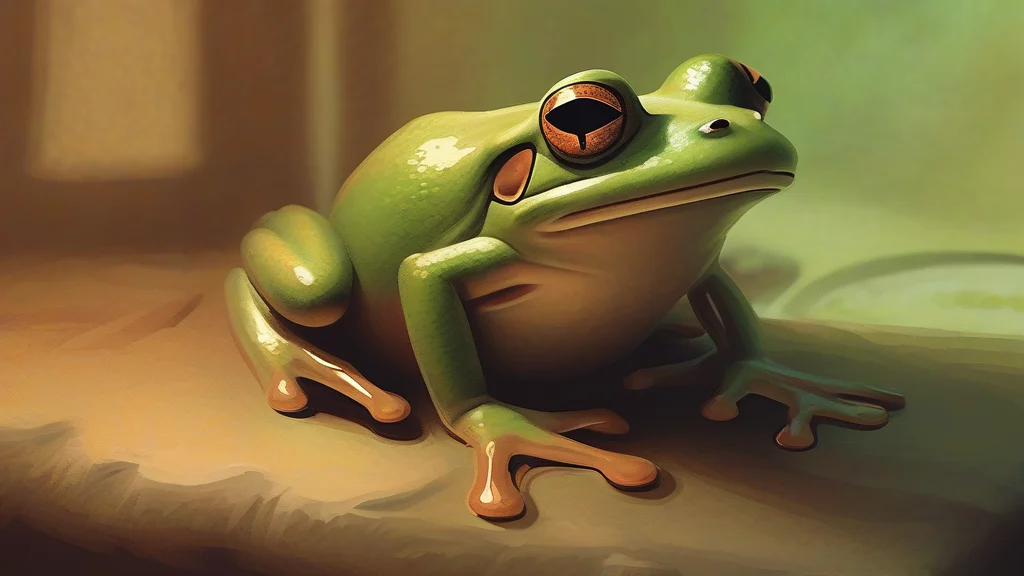
What does froggy mean?
Froggy is an informal English adjective whose dominant meaning today concerns the voice: a froggy voice is one that sounds hoarse, low, or croaking, as though its owner had a frog lodged in the throat. The word equally evokes the amphibian itself, describing anything frog-like — damp, greenish, given to lurking around ponds. Children's books and playground language keep this second sense lively, while cold-and-flu season keeps the first in constant circulation. Froggy carries a mild, often endearing connotation rather than a harsh one; a singer might deliberately cultivate a slightly froggy rasp for warmth and texture. The word derives straightforwardly from the Old English root behind 'frog', and its playful suffixing follows a long line of animal adjectives like doggy and piggy. One caution belongs in any honest account: froggy was historically used as an insulting label for French people, a derogatory sense now rightly retired from polite use. In contemporary writing, stick to voices, ponds, and puddles — the senses that make froggy useful, familiar, and charming.
Resembling or characteristic of a frog; especially having a low, hoarse, croaking sound.
"His voice came out froggy after a weekend of coaching in the cold rain."
Informal register; the vocal sense is the most frequent in modern use.
A small frog, used playfully or childishly.
"The toddler crouched over the froggy in the garden puddle, refusing to come inside."
Rare and informal outside children's language.
'If you're feeling froggy, then jump' — a playground taunt that kept this humble adjective alive as pop-culture shorthand for being ready to fight.
Reviewed by Deb Chak, Editor. AI-assisted content curated by RJS Tech Solutions LLP.
Etymology of froggy
Froggy is a straightforward derivative of 'frog', a native Germanic word recorded in Old English as 'frogga' or 'frosc', whose deeper origins remain uncertain — possibly imitative of the animal's croak or linked to old words for hopping creatures. The adjective formed by adding the familiar diminutive-style '-y' suffix, much as 'doggy' and 'piggy' were formed from their animals, likely in the early modern period when such playful forms flourished. Its vocal application grew naturally out of the resemblance between a hoarse voice and a frog's croak. Cognate forms across other Germanic languages preserve related frog-words, reflecting a shared Germanic heritage rather than borrowing from Latin or Greek.
Related word forms
How froggy is actually used
Froggy is firmly informal and conversational — fine in casual speech, children's writing, and light prose, but out of place in formal registers. Its most common modern use is vocal: describing hoarseness from illness, shouting, or nerves. The historical ethnic sense targeting French people is genuinely part of the record but is derogatory and should not be repeated casually; writers today encounter it mainly in older texts.
Easily confused with froggy
Frog is the amphibian itself, while froggy is an adjective describing a frog-like quality, most often in someone's voice.
Foggy means blurred or mist-covered, whereas froggy refers to a hoarse, croaking quality or frog-like character.