What does froghopper mean?
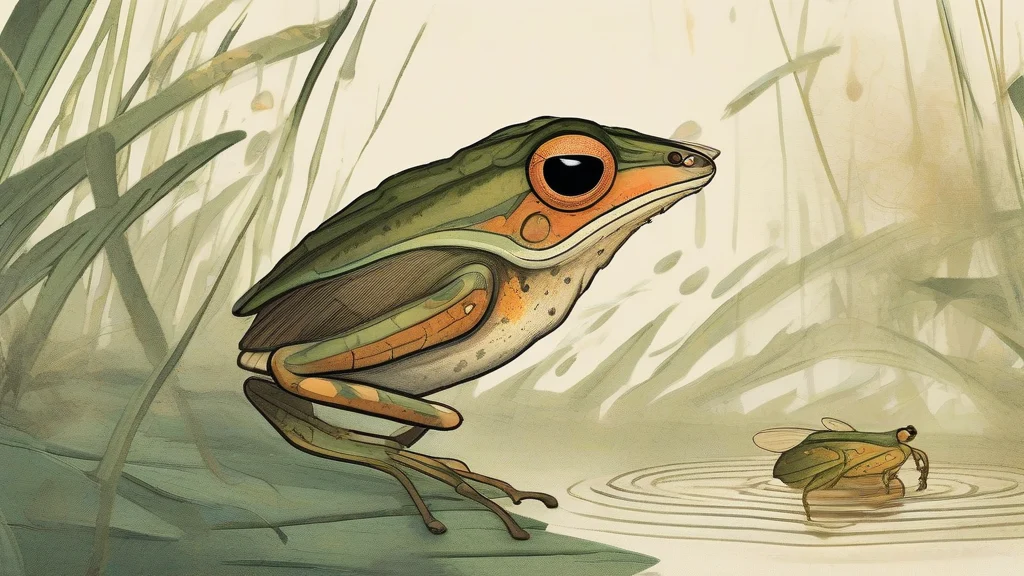
A froghopper is a small, stocky, sap-sucking insect belonging to the group known scientifically as Cercopoidea, related to cicadas and leafhoppers. Adults are strong jumpers, propelling themselves with enlarged hind legs, which—along with a somewhat frog-like facial profile—earned them their common name. The insects are most familiar to gardeners not as adults but in their juvenile stage: the nymphs feed on plant sap and excrete a distinctive white foam, popularly called cuckoo spit or spittle, that shelters them from predators and desiccation. In North American usage these insects are more commonly referred to as spittlebugs, while froghopper is the prevailing name in Britain and much of Europe. Though occasionally abundant enough to blemish ornamental plants, froghoppers are generally harmless, and their extraordinary leaping ability—one of the most powerful relative jumps in the animal kingdom—makes them a perennial subject of fascination for entomologists.
nounA small jumping insect of the superfamily Cercopoidea, whose aquatic nymphs surround themselves with a protective mass of froth, commonly known as cuckoo spit or spittle.
- Any small, stout, jumping hemipteran insect of the superfamily Cercopoidea, whose nymphs encase themselves in frothy 'cuckoo spit' while feeding on plant sap.
"The garden's rose stems were flecked with cuckoo spit, each blob hiding a tiny froghopper nymph."
"Gardeners who spot blobs of white foam on lavender stems are looking at the handiwork of froghopper nymphs."
"The common froghopper, Philaenus spumarius, can leap more than a hundred times its own body length."
Standard regular plural; singular froghopper remains the norm when referring to an individual specimen.
"By midsummer, froghoppers were scattered across every stem in the meadow."
Pound for pound, the froghopper is one of the best jumpers on Earth — it can leap around 70 centimetres into the air, the equivalent of a human clearing a skyscraper.
Reviewed by Deb Chak, Editor. AI-assisted content curated by RJS Tech Solutions LLP.
Etymology of froghopper
The name froghopper is a straightforward English compound formed from 'frog' and 'hopper', coined to describe an insect that hops powerfully and has a blunt, somewhat frog-like appearance. It belongs to a family of vernacular insect names built on descriptive compounds, alongside terms like grasshopper and leafhopper. The word entered general use through nineteenth- and twentieth-century natural-history writing rather than having a classical origin, so it shares roots not with Latin or Greek but with native English words derived from 'frog' and the agentive '-hopper' pattern.
How froghopper is actually used
Froghopper is used chiefly in British English natural-history and gardening contexts; in North America the same insects are more often called spittlebugs. The name derives from the insect's frog-like face and powerful leaping ability.
Easily confused with froghopper
A grasshopper is a much larger herbivorous insect with long hind legs and prominent antennae, whereas a froghopper is a small sap-sucking insect best known for the foamy 'spittle' produced by its nymphs.