
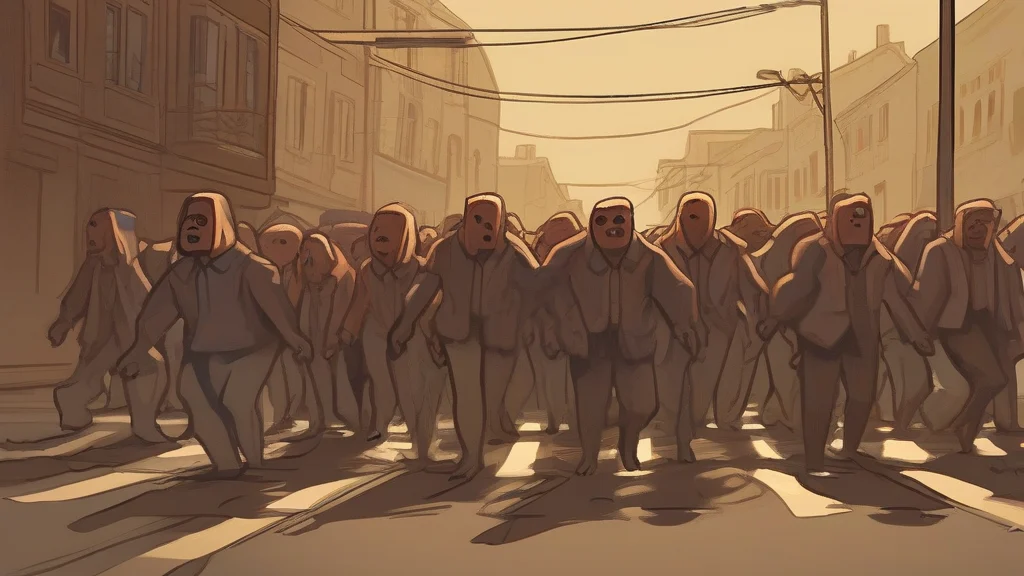
What does frogmarch mean?
Frogmarch is a chiefly British military term for forcing a prisoner or other captive to move on foot while holding both arms straight out at the sides. The posture makes the person resemble a frog and turns the march into an exhausting, humiliating punishment. As a verb, frogmarch means to subject someone to that treatment; frogmarched is the usual past-tense form. In figurative use, the verb can describe making someone go somewhere rapidly and unwillingly, usually under rough handling or pressure, although the military origin remains the source of its imagery. The word has an old-fashioned, institutional register and is rarely emotionally neutral when applied to people. It remains memorable because its compact image captures both compulsory movement and physical degradation. Modern speakers may encounter it in accounts of war, imprisonment, policing or protest, while ordinary conversation more often uses drive, drag or march. The term is uncommon in general American English but appears in American military and historical writing.
A forced march in which prisoners or other captives are made to walk with their arms held straight out at their sides, so that they resemble frogs.
"The officers subjected the prisoners to a brutal frogmarch."
Countable and relatively uncommon, but regularly used in military history and reporting on prisoner treatment.
To force someone to march with their arms extended, especially as a military punishment; figuratively, to compel someone to move unwillingly or roughly.
"Guards frogmarched the detainee down the corridor."
Often transitive and strongly suggestive of coercion and humiliation.
The countable plural is frogmarches, although the word is often used attributively to describe a punishment or the treatment of prisoners.
"The report documented several frogmarches during the night."
Held with both arms stretched out at the sides, the marching prisoner looks uncomfortably like a frog.
Reviewed by Deb Chak, Editor. AI-assisted content curated by RJS Tech Solutions LLP.
Where does frogmarch come from?
The compound arose in British military English in the early twentieth century. It combines frog with march, alluding to the prisoner's outstretched-arm posture rather than to the manner of walking. Its military sense developed from the forced procession or punishment described by that image; unlike many military compounds, it does not have a shared classical linguistic root.
Related word forms
How frogmarch is actually used
The expression has a coercive, humiliating and somewhat archaic military register. Figurative use emphasizes reluctant movement or rough handling, while the noun also has a strong historical association with prisoner-of-war treatment.