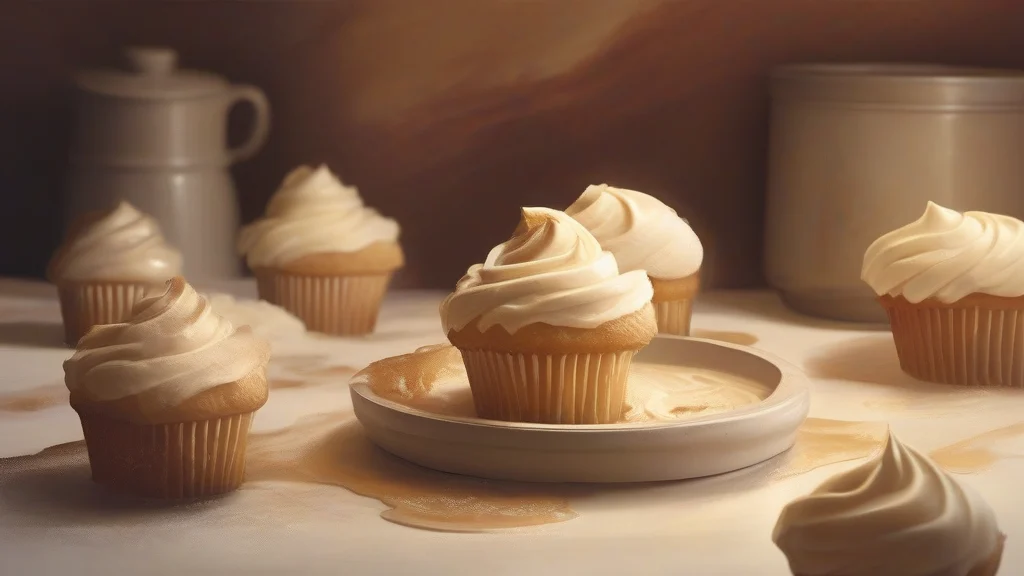
What does frosting mean?
Frosting is a sweet, creamy substance — usually built from powdered sugar combined with butter, cream cheese, milk, or egg white — that is spread over or piped onto cakes, cupcakes, cookies, and other baked goods to add flavour, sweetness, and decorative finish. It is the standard American term; British English prefers 'icing', where 'frosting' can even sound slightly exotic. Frosting ranges from dense buttercreams to light whipped varieties, and its consistency matters as much as its taste: stiff enough to hold shapes like rosettes and swirls, soft enough to spread smoothly. Beyond the kitchen, the word occasionally appears figuratively, treating something pleasant as an indulgent finishing touch. For learners of English, it is useful chiefly in culinary contexts, recipes, and baking culture, where it appears constantly in both everyday conversation and commercial packaging.
nounA sweet, creamy mixture, typically made from sugar and butter or other fat, spread over or piped onto cakes, cupcakes, and pastries as a topping or filling. In British English the term 'icing' is more common for this substance.
- A sweet, creamy sugar-based coating or filling for cakes and pastries
- The formation of frost on a surface (rare, derived sense)
"She swirled a thick layer of chocolate frosting over the birthday cake."
"The baker piped rosettes of pink frosting around the top of the cupcake."
"A generous layer of cream cheese frosting made the carrot cake irresistible."
The plural appears mainly when distinguishing between different types or recipes of frosting, such as in cookbooks or bakery menus.
"The bakery offers several frostings, including chocolate, vanilla, and lemon."
American bakers say 'frosting', Brits say 'icing' — but the sugary battle of terms never melted anyone's cake.
Reviewed by Deb Chak, Editor. AI-assisted content curated by RJS Tech Solutions LLP.
Etymology of frosting
Frosting derives from 'frost', a word of Germanic origin referring to the frozen white coating that cold weather leaves on surfaces, with roots traceable through Old English 'frost' to Proto-Germanic origins. The culinary application likens the pale, crystalline appearance of sugar coatings to frost on a windowpane, a comparison also reflected in the parallel development of 'icing' from 'ice'. The suffix '-ing' here forms a noun denoting a substance or material rather than an action.
How frosting is actually used
The word is chiefly American English; British speakers overwhelmingly use 'icing'. In American culinary writing, 'frosting' tends to denote thick, spreadable toppings (such as buttercream), while 'glaze' covers thinner coatings.
Easily confused with frosting
Icing is the standard British term for the same sweet coating; in American usage, icing often suggests a thinner glaze while frosting is thicker and fluffier.