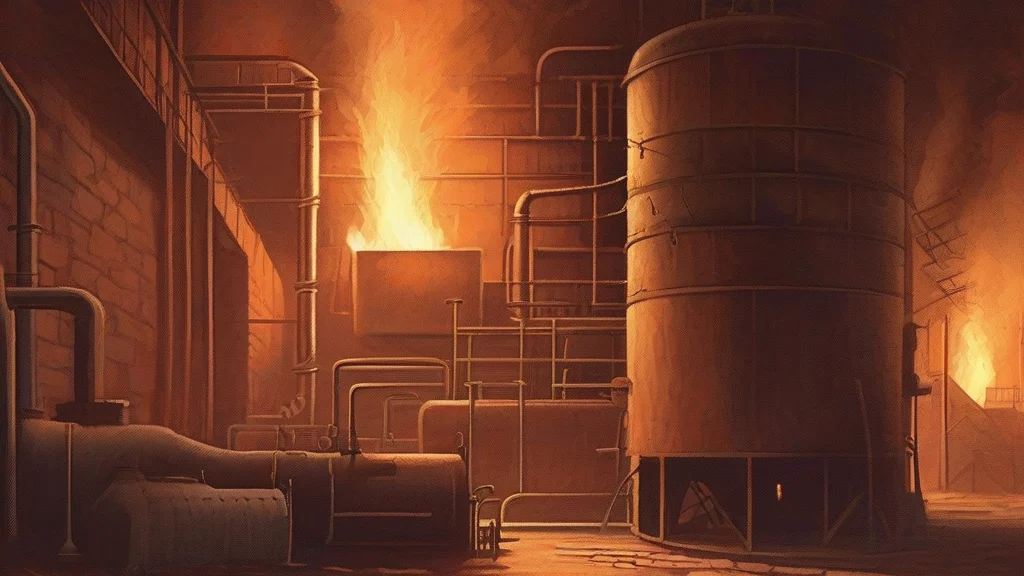
What does furnace mean?
A furnace is an enclosed apparatus designed to generate intense heat for a practical purpose. In everyday domestic contexts, especially North America, it names the central-heating unit that burns gas, oil, or uses electricity to warm a building's air. In industry, the word covers far larger and hotter structures — blast furnaces that smelt iron ore into molten metal, electric furnaces that produce steel or glass, and incinerating furnaces that consume waste. The word also functions figuratively: a scorching summer afternoon or a harrowing ordeal is often described as 'like a furnace', evoking oppressive, punishing heat. Connotations therefore range from the mundane comfort of a warmed home to the drama of molten metal and biblical trials by fire. Derived from the Latin 'fornax' meaning oven, the word entered English in the medieval period and remains indispensable wherever heat production is described.
nounAn enclosed structure or appliance in which heat is generated, typically for heating a building, smelting metal, or powering industrial processes.
- A domestic heating unit that warms air or water to heat a building.
- An industrial enclosure for very high temperatures, used in smelting metals, glassmaking, or incineration.
- (Figurative) An intensely hot place or situation, or one of severe trial or suffering.
"The old boiler finally gave out, and the repair technician installed a new gas furnace the following morning."
"The technician replaced the failing furnace just before the first cold snap of winter."
"Molten iron poured from the blast furnace in a blinding orange stream."
"The valley in high summer was like a furnace, the air shimmering above the asphalt."
Standard plural; unchanged in spelling apart from adding -s. Commonly used of multiple industrial installations.
"The steelworks shut down its four remaining blast furnaces last year."
'Furnace' traces back to the Latin 'fornax', meaning oven — and that same root, via 'fornix' (a vaulted arch), gave English the term 'fornication', which originally described simply the arched cellars where Romans baked bread.
Reviewed by Deb Chak, Editor. AI-assisted content curated by RJS Tech Solutions LLP.
Etymology of furnace
The word 'furnace' derives from Latin 'fornax', meaning an oven or kiln, a root it shares with the constellation name Fornax and, through the related Latin term 'fornix' meaning a vaulted arch, with words connected to arched structures. It entered Middle English from Old French during the medieval period, when such borrowing supplied much of England's technical vocabulary. The modern English form has been stable for centuries, retaining its core sense of a heated chamber across domestic and industrial contexts.
Related word forms
How furnace is actually used
In American usage, 'furnace' almost always refers to a household central-heating unit burning gas, oil, or electricity; in British usage it more often connotes an industrial furnace, home heating being described by terms like 'boiler'. The figurative sense ('a furnace of a day') is common in both regions and carries an implication of oppressive heat rather than comfort.
Easily confused with furnace
Despite the similar spelling, 'furnish' means to supply a room or building with furniture and fittings, whereas 'furnace' is a heating apparatus.