What does forge mean?
Forge is a versatile English word that operates as both a noun and a verb, bridging two very different worlds: craftsmanship and deception. In the workshop sense, a forge is the hearth on which a blacksmith heats metal before shaping it by hammering, and 'to forge' iron or steel is to work it into a desired form — a process associated with strength and durability. In its other sense, 'to forge' means to produce a fraudulent imitation of something, most commonly a signature, document, banknote, or work of art. Perhaps surprisingly, both senses descend from the same Latin source relating to the smith's workshop, so the link between making things and faking things runs deep in the word's history. Beyond these core uses, 'forge' has developed an idiomatic, aspirational meaning: people are said to 'forge' partnerships, careers, and friendships, building them steadily through effort, and to 'forge ahead' when pressing onward against difficulty. Few words so neatly capture both the honest labour of creation and the crime of imitation.
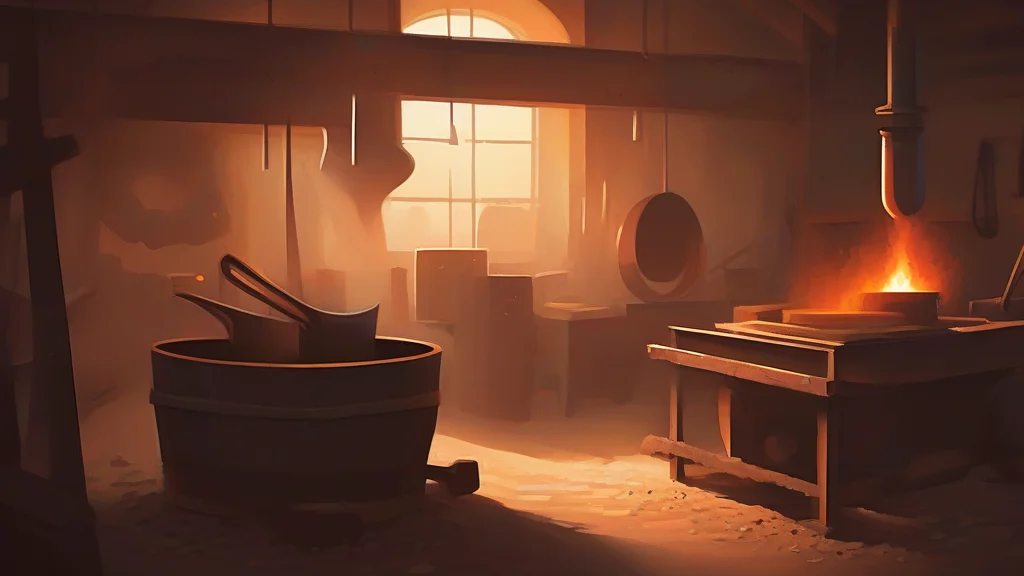
A furnace or hearth used by a blacksmith for heating metal prior to shaping it by hammering; by extension, sometimes a smithy itself.
"The village blacksmith pumped the bellows to bring the forge up to temperature."
In foundries, the term may also refer to a furnace used for forging operations.
To shape metal by heating it in a fire and hammering it; alternatively, to fraudulently produce a copy of a document, signature, or other object with intent to deceive; more broadly, to establish or create something through sustained effort.
"The two countries forged a trade agreement that would last for decades."
The 'create through effort' sense is always positive or neutral, whereas the 'counterfeit' sense carries strong criminal connotation.
Standard plural; applies only to the noun sense referring to smithies or furnaces.
"The open-air museum featured several working forges from different historical periods."
The word for both hammering hot iron and faking a signature traces back to a single Latin word meaning 'workshop' — craft and counterfeit share one birthplace.
Reviewed by Deb Chak, Editor. AI-assisted content curated by RJS Tech Solutions LLP.
Etymology of forge
The word derives ultimately from the Latin 'fabrica', meaning a workshop or craft, which also gave English 'fabricate' and 'fabric'. It entered English through Old French: 'forge' as the name of a smithy appeared in medieval French, while the verb 'to forge' came via French 'forger', meaning to work metal. By the sixteenth century the sense of counterfeiting had emerged, likely influenced by the notion of a forger working material into shape — whether honestly at the anvil or dishonestly on paper.
Related word forms
How forge is actually used
'Forge' is neutral in register but its connotation depends heavily on context: in discussions of documents or art it implies criminal deception, while in political and personal contexts ('forge a friendship', 'forge ahead') it carries strongly positive connotations of determination and creation. The two meanings coexist without confusion because context almost always signals which is intended.
Easily confused with forge
'Forage' means to search widely for food or supplies, while 'forge' means to shape metal or create a fraudulent copy — the two words look and sound similar but are entirely unrelated in meaning.