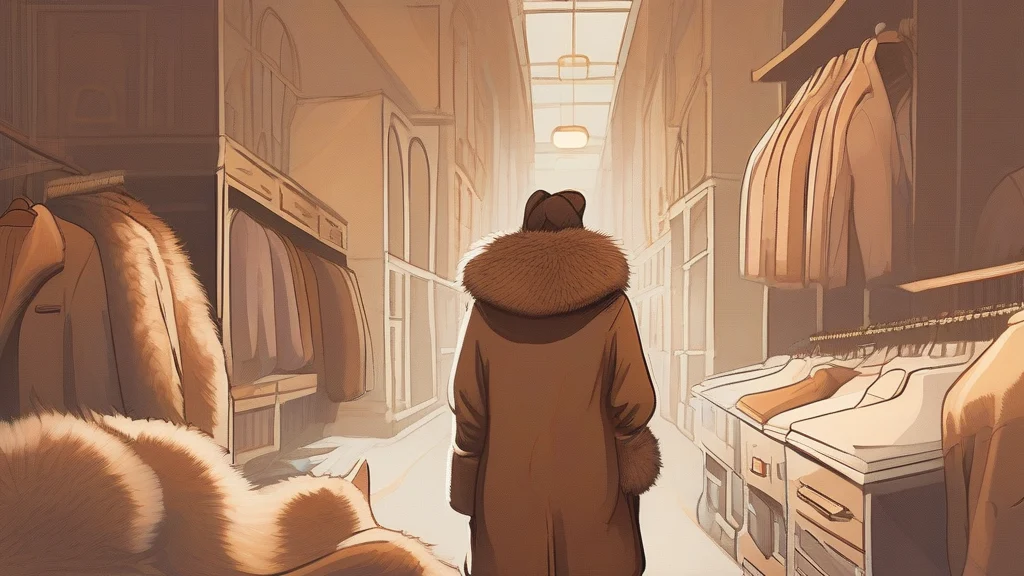
What does furrier mean?
A furrier is a craftsperson and merchant who specializes in fur: buying and grading animal pelts, and designing, making, altering, repairing, and cleaning garments such as coats, stoles, hats, and trims. Historically a prestigious and lucrative trade — royal courts maintained official furriers because furs like ermine and sable signified rank and wealth — the occupation persists today chiefly in luxury fashion, garment care, and the trade in vintage furs. The word derives ultimately from Old French 'forrer', to line a garment with fur, itself from 'fourre', a sheath or lining. English speakers should be aware that 'furrier' is also simply the comparative of the adjective 'furry', meaning 'more furry'; sentence context and grammar almost always disambiguate the two uses. A shop run by one is often styled a furrier's, much as one speaks of a tailor's.
A person who deals in, makes, repairs, or cleans fur garments and processed animal pelts.
"The furrier examined each marten pelt under a bright lamp before bidding at the auction."
Often used with possessive 's ('the furrier's') to refer to the establishment itself, by analogy with 'tailor's' or 'butcher's'.
Comparative form of 'furry': more covered with, made of, or resembling fur.
"The angora rabbit is far furrier than the average house cat."
This is simply the regular comparative of 'furry', not a separate lexical item; dictionaries typically list it as an inflected form rather than a distinct entry.
Standard plural for the noun referring to multiple people in the trade; 'furriers' can also denote shops or firms in the business collectively.
"The city's remaining furriers have adapted by specializing in restoration and heirloom care."
In medieval England, the king's furrier was one of the most powerful merchants at court — ermine wasn't just warm, it was law: only royalty could wear it.
Reviewed by Deb Chak, Editor. AI-assisted content curated by RJS Tech Solutions LLP.
Etymology of furrier
The noun 'furrier' came into English in the medieval period from Old French 'fourreur', an agent noun derived from 'forrer' (later 'fourrer'), meaning to line or sheathe a garment — literally to furnish clothing with a fur lining. The underlying Old French 'fo(u)rre' denoted a sheath or lining, and the same family of words gave English its word 'fur'. The adjective use of 'furrier' is unrelated in origin beyond sharing the base word 'furry': it is simply the ordinary comparative of that adjective.
How furrier is actually used
The noun is a somewhat traditional trade term, now less common as the fur trade has declined, though it remains standard in fashion and luxury-goods contexts. Note also that 'furrier' doubles as the comparative form of the adjective 'furry', so readers may meet it in either role; the possessive-style spelling 'furrier's' often denotes the shop itself.
Easily confused with furrier
As the comparative of the adjective 'furry', furrier means 'more furry' (a furrier blanket), whereas the noun furrier is a person who sells or works with fur — context and grammar make clear which is meant.
A farrier shoes horses, while a furrier works with animal pelts and fur garments.