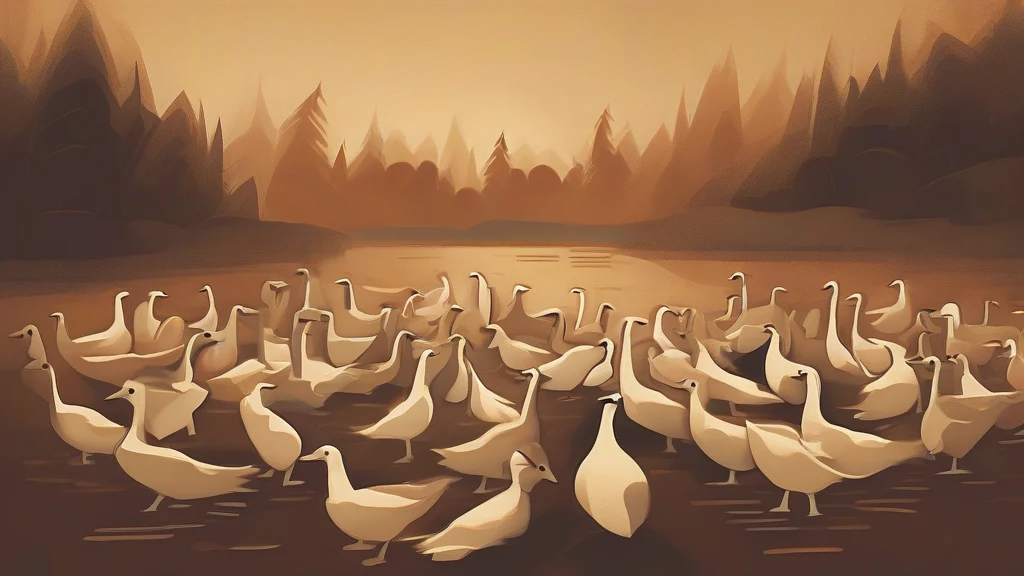
What does gaggle mean?
A gaggle is a collective noun denoting a flock of geese, particularly when gathered on the ground or floating on water. By extension, it has come to describe any noisy, disorderly group of people — a gaggle of tourists, journalists, or children — lending the phrase a lightly comic, slightly chaotic flavor. The word belongs to the charming English tradition of specialized animal collective nouns, alongside 'murder' of crows and 'pride' of lions; traditionally, geese in the air form a 'skein' or 'wedge', while only those on land or water form a gaggle. In modern usage the human sense is common in journalism and everyday speech, usually implying harmless commotion rather than genuine disorder. Its vivid association with honking, jostling geese makes it an expressive and memorable alternative to plainer words like 'group' or 'crowd'.
nounA gaggle is a flock of geese, especially when on the ground or in the water. It also refers more broadly to a noisy, disorderly group of people.
- A flock of geese, especially when on the ground or water (as opposed to a 'skein' in flight).
- A noisy, disorderly or untidy group of people.
"A gaggle of tourists crowded around the museum entrance, consulting their maps."
"The pond was crowded with a gaggle of honking Canada geese."
"A gaggle of schoolchildren spilled noisily out of the bus and onto the pavement."
The plural 'gaggles' is used when referring to more than one such group.
"Several gaggles of geese settled along the riverbank at dusk."
Geese are grammar: in flight they're a 'skein', but once they land and start honking, they officially become a 'gaggle'.
Reviewed by Deb Chak, Editor. AI-assisted content curated by RJS Tech Solutions LLP.
Etymology of gaggle
The word 'gaggle' derives from 'gagel', an Old Norse term related to the bird's cry, and is generally traced to Middle English, where it appears as a collective term for geese. It belongs to a family of imitative words reflecting the honking or chattering sound associated with geese, connected by some scholars to the same Germanic root that produced 'gabble'. The extension to groups of people developed later, drawing on the noisy character of the bird itself.
How gaggle is actually used
The word carries a mildly humorous or affectionate connotation when applied to people, suggesting good-natured chaos rather than menace. The goose sense follows the old tradition of distinct collective nouns for animals; strictly, 'gaggle' applies to geese on the ground or water, while a group in flight is a 'skein' or 'wedge', though many speakers use 'gaggle' regardless.
Easily confused with gaggle
'Goggle' means to stare with wide eyes, while 'gaggle' refers to a noisy group of geese or people.
'Giggle' is a light, silly laugh, whereas 'gaggle' denotes a flock of geese or a disorderly crowd.