
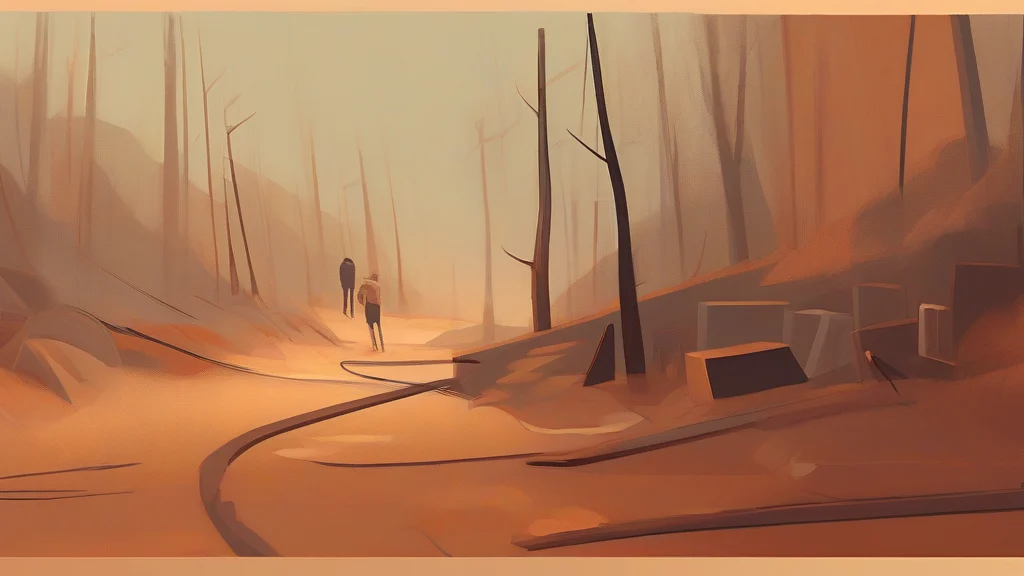
What does straggle mean?
Straggle most often means to move or remain behind the main group, especially slowly or in a scattered way. “The last runner straggled across the line,” for example, suggests a delay accompanied by loss of order rather than mere lateness. The verb can also mean to wander or move about without a clear course, as when tired hikers drift into a village one by one. Straggle appears in both British and American English and is especially natural in descriptions of troops, travelers, runners, and other groups expected to stay together. Its tone ranges from neutral to mildly disapproving: it may suggest poor discipline or an unhurried failure to keep pace, depending on context. The related noun straggler names the person or thing that falls behind, while straggle focuses on the action of lagging or wandering. The word is consequently useful for describing not a complete stop, but a gradual separation from the expected group or course.
verbTo move or remain behind a group, especially slowly or in a scattered way. It can also mean to wander or move about without a definite course or destination.
- To lag behind or fail to keep up with a group, especially in a slow, scattered, or disordered way.
- To wander or move about without a definite course or destination.
"A few tired hikers straggled into the station just as the train pulled in."
"The last soldiers straggled behind the advancing column."
"Several runners straggled across the finish line minutes after the leaders."
Straggle captures a very specific kind of disorder: not stopping, but continuing while the group pulls away.
Reviewed by Deb Chak, Editor. AI-assisted content curated by RJS Tech Solutions LLP.
Where does straggle come from?
The word dates from the late 16th century, when it referred to a wanderer or vagrant; the verb initially meant to wander and later acquired the sense of lagging behind. Its immediate source was a dialectal verb meaning “to wander or loiter,” although the deeper origin is uncertain. The related agent noun straggler developed for a person who wandered from or fell behind a group.
Related word forms
How straggle is actually used
The word often implies both delay and separation from a group. Its tone ranges from neutral to mildly disapproving, particularly when describing people expected to maintain formation or keep pace.
Easily confused with straggle
A straggler is a person or thing that falls behind or separates from the group, whereas straggle usually describes the act of lagging or wandering behind.