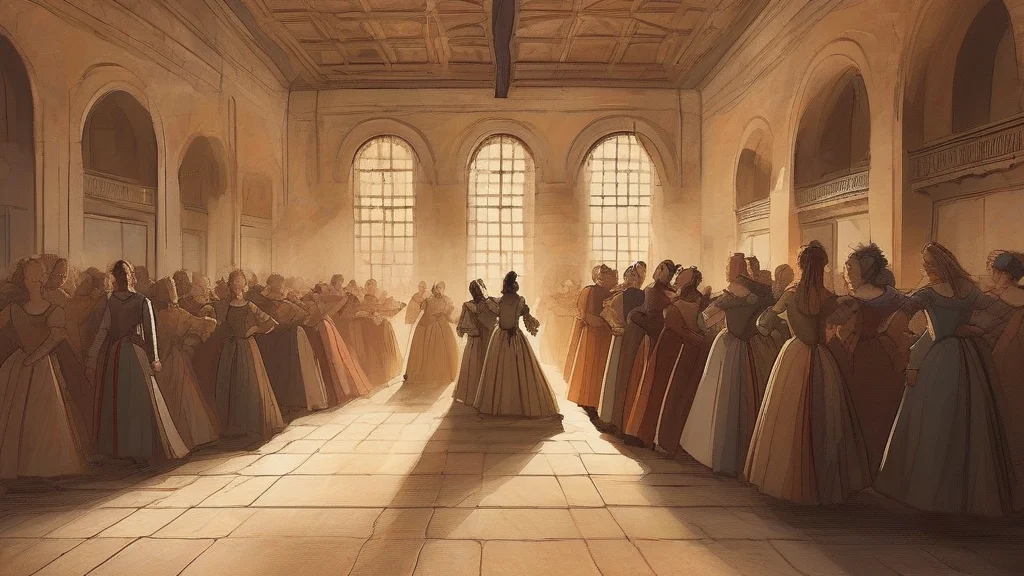
What does galliard mean?
The galliard is a lively dance that swept across European courts in the sixteenth and early seventeenth centuries. Set in triple metre and danced to energetic music, it featured leaps, hops, and kicks, making it one of the more athletic figures of the Renaissance repertoire; dancers frequently performed it immediately after the stately, processional pavan, creating a deliberate contrast between slow grandeur and quick exuberance. The name derives ultimately from Old French 'gaillard', meaning bold or joyful, which reflects the spirit of the dance itself. Today 'galliard' appears mainly in historical musicology, period drama, and the works of Shakespeare, where characters are sometimes said to trip a galliard on stage. For modern readers it offers a vivid window into the courtly culture of Tudor England, when skill in the dance could signal both physical vigour and social polish.
nounA lively Renaissance dance in triple metre, popular in Europe during the 16th and early 17th centuries, typically performed with vigorous leaps and hops. It was often paired as an after-dance with the slower pavan.
- A lively 16th-century European dance in triple metre, characterised by leaps, kicks, and hops, usually danced after a pavan.
- (historical) The musical piece composed to accompany this dance.
- (archaic) A person who is gay, brisk, and full of high spirits.
"The courtiers opened the ball with a spirited galliard, their heels striking the floor in time with the brisk music."
"At the Elizabethan revels, couples leapt through a galliard while musicians hammered out the rhythm on drums and viols."
"Shakespeare has Malvolio imagine himself calling for his cousin Toby to fill the hall with dances, including his 'brown bills' and the galliard."
Standard plural; used when referring to multiple instances of the dance or its music.
"The programme included pavans, galliards, and almains from the Fitzwilliam Virginal Book."
Queen Elizabeth I reportedly performed six galliards before breakfast each morning — a royal cardio routine set to music.
Reviewed by Deb Chak, Editor. AI-assisted content curated by RJS Tech Solutions LLP.
Etymology of galliard
The word enters English from Old French 'gaillart', meaning gay, brisk, and bold, whose ultimate origin lies in medieval Latin terms associated with joy and merriment. It first appears in English in the sixteenth century, when the dance it names became fashionable at court. The same Old French root produced the English adjective 'gallant' and the festive term 'gala', all carrying connotations of liveliness and celebration.
How galliard is actually used
The word survives almost entirely in historical, early-music, and Shakespearean contexts; outside discussions of Renaissance dance it would sound archaic. An older adjectival sense ('bold, merry') exists but is obsolete.
Easily confused with galliard
"Gaillard" is the French spelling/adjective meaning bold or merry, whereas "galliard" is the English form, chiefly used today for the Renaissance dance.
"Gallant" means brave, chivalrous, or showily courteous, while "galliard" refers to a lively Renaissance dance.