
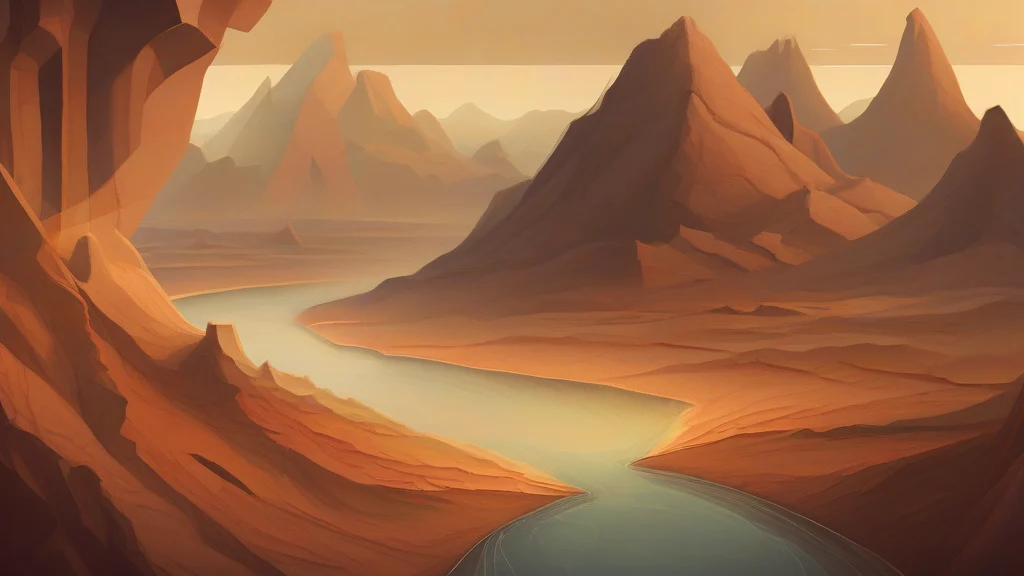
What does geomorphology mean?
Geomorphology is the branch of physical geography that studies the Earth's landforms and the processes that create, modify, and remove them. It examines features such as mountains, valleys, floodplains, coastlines, dunes, and glaciers, as well as the actions of water, wind, ice, waves, and gravity that shape them. The term is especially common in academic and scientific writing, with subfields such as fluvial, coastal, glacial, and desert geomorphology. Geomorphological research can explain how landscapes formed, why erosion patterns differ from one region to another, and how environmental changes may alter a landscape over time. The word is also associated with a broader way of seeing terrain as evidence of natural history. Its value lies in connecting present-day scenery with the forces and environmental conditions that produced it.
nounThe branch of physical geography concerned with the origin, formation, and evolution of landforms and with the processes that shape the Earth's surface. It includes the study of features such as mountains, valleys, rivers, coastlines, dunes, and glaciers.
- The scientific study of landforms, their origins, and the natural processes that shape and transform the Earth's surface.
"The course examines coastal geomorphology and the ways waves and tides reshape shorelines."
"Geomorphology helps researchers understand why a river abandoned one channel and began flowing through another."
"The report uses geomorphology to explain the formation of the sand dunes protecting the coastal town."
The singular form is standard when naming the discipline as a whole; plural forms are uncommon and are used when referring to distinct bodies or forms of geomorphological study.
"The seminar compared the geomorphologies of several coastal regions."
Geomorphology reads the landscape as a record of forces in motion: rivers cut, glaciers carve, waves rearrange, and wind sculpt.
Reviewed by Deb Chak, Editor. AI-assisted content curated by RJS Tech Solutions LLP.
Where does geomorphology come from?
Geomorphology is an English formation dating from the 19th century, combining Greek geō, meaning “earth,” with morphē, meaning “form,” and the study-forming element -logia. The latter is derived from Greek logos, in the sense of account, reason, or study. Related English terms such as geography, geology, and morphology are built from the same Greek elements or their derivatives.
Related word forms
How geomorphology is actually used
This is a formal academic term, usually used as an uncountable noun when referring to the discipline. Its related adjective is geomorphological, and the specialist is a geomorphologist.
Easily confused with geomorphology
Geomorphology focuses specifically on landforms and the processes that create or modify them, whereas geography is the broader study of places, environments, and human-environment relationships.
Topography describes or maps the physical shape and elevation of land, while geomorphology investigates how those forms originated and how they change.