
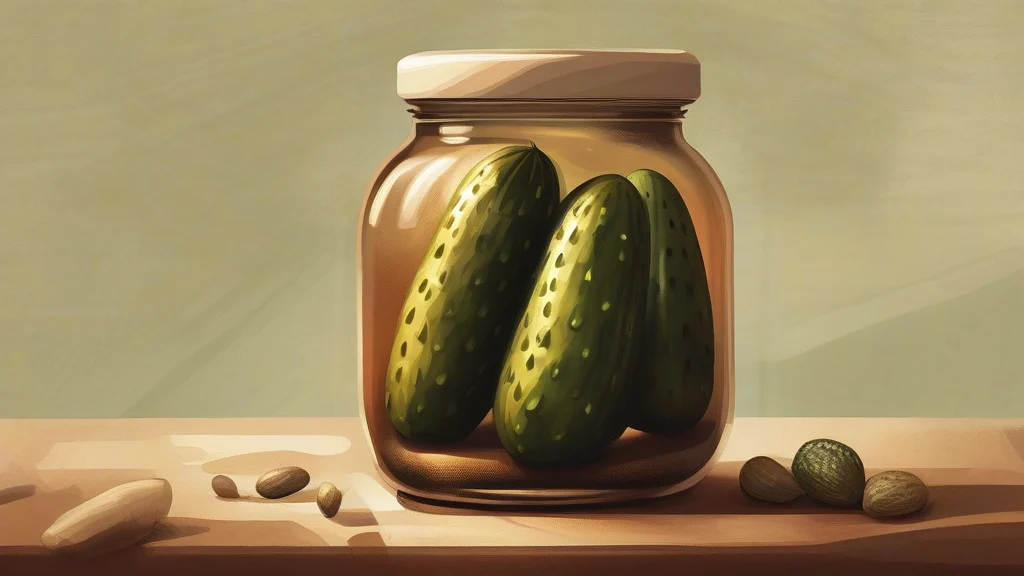
What does gherkin mean?
Gherkin is a culinary word for a small cucumber, especially a cucumber preserved in brine or vinegar. The distinction is mainly regional: North American speakers commonly use gherkin for a sour pickle, while British and international usage may also call a fresh, small cucumber a gherkin. Either way, the word evokes the crisp texture and sharp, vinegary flavor of small cucumbers served in sandwiches, alongside burgers, or in pickle jars. Its unusual name reflects its history: the English word came from Dutch gherkijn, literally a diminutive meaning “little cucumber.” The same Latin root that ultimately produced gherkin also lies behind cucumber and the broad cucurbit family of gourds, melons, and squash. In everyday restaurant ordering, gherkin often implies both the vegetable’s small size and its preserved, acidic character, making it a useful word when precision about what is in the jar matters.
nounA small cucumber, especially one pickled in brine or vinegar. In North American usage, the word often refers specifically to a pickled cucumber.
- A small cucumber preserved in brine or vinegar, especially a sour pickle.
- A fresh, small cucumber, particularly in British and international usage.
"She added sliced gherkins and a spoonful of mustard to the crisp sandwiches."
"The deli serves sandwiches with thick-cut gherkins and sharp mustard."
"Garden gherkins can be harvested young and pickled in dill brine."
The plural is used for individual small cucumbers or pickles.
"The recipe calls for three gherkins and a teaspoon of mustard."
A gherkin is literally a “little cucumber”—and in North America, usually one that has met vinegar.
Reviewed by Deb Chak, Editor. AI-assisted content curated by RJS Tech Solutions LLP.
Etymology of gherkin
The word entered English in the early 17th century from Dutch gherkijn, a diminutive meaning “little cucumber.” Dutch gurk, the base of that form, belongs to a Germanic loan tradition whose ultimate source is Latin cucumis. English established the culinary meaning “small cucumber,” especially one kept in brine or vinegar.
How gherkin is actually used
The term is neutral and common in culinary contexts. North American usage tends to emphasize the pickled form, while British and international usage more often treats gherkin as the name for a small cucumber, whether fresh or preserved.