
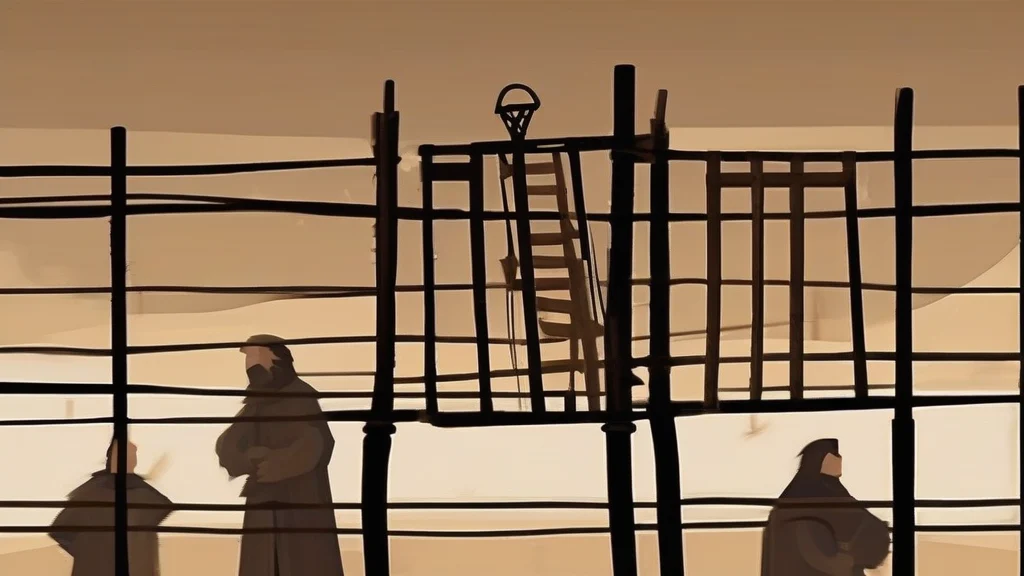
What does gibbeting mean?
Gibbeting was a severe historical form of capital punishment associated especially with the gibbet, a tall wooden post fitted with an arm or beam for suspending a person. A condemned person might be hanged alive, killed by another method and then displayed, or fastened to the structure after execution. The body was left exposed as a public warning, often intended to demonstrate the authority of the government and discourage rebellion or crime. In historical writing, “gibbeting” can refer both to the punishment and more broadly to the public display of a body on a gibbet. The word is related to the older noun “gibbet” and the historical verb “to gibbet,” meaning to hang or expose someone on such a structure. Although the practice has largely disappeared from modern legal use, the term survives in accounts of state punishment, public executions, and the punishment of notorious criminals such as pirates.
A punishment in which a condemned person is hung on a gibbet or otherwise fastened to it, with the body left exposed as a public warning.
"The proclamation described the punishment as immediate gibbeting before a public audience."
The noun is now chiefly historical and may denote either the punishment or the practice of displaying the body.
To hang or display a condemned person on a gibbet as punishment.
"After the rebellion was suppressed, the authorities gibbeted several captured conspirators."
This is a historical transitive verb and is rarely used in contemporary writing.
The plural is rare because the noun is chiefly used in historical accounts.
"The records describe the gibbetings of convicted rebels in several provincial towns."
Gibbeting turned death into public theater, suspending a body over a community as a grim warning against rebellion or crime.
Reviewed by Deb Chak, Editor. AI-assisted content curated by RJS Tech Solutions LLP.
Where does gibbeting come from?
The word comes through Middle English gibet from Old French gibet, with Medieval Latin gibbettus also attested; the ultimate origin of this stem is uncertain. The verb “gibbet” and its gerund or noun form “gibbeting” developed from that base, with “gibbet” denoting both the punishment and the wooden structure used for hanging or displaying a person. Related forms such as “gibbet-tree,” “gibbet staff,” and “gibbet iron” preserve the same historical sense of a structure, beam, or fitting used to suspend a condemned person.
Related word forms
How gibbeting is actually used
The term is now chiefly historical and uncommon in modern standard English. It carries strong connotations of capital punishment, bodily display, and the use of state authority to intimidate the public.
Easily confused with gibbeting
A gibbet is the wooden structure used for hanging or displaying a person, whereas gibbeting is the act or punishment itself.