
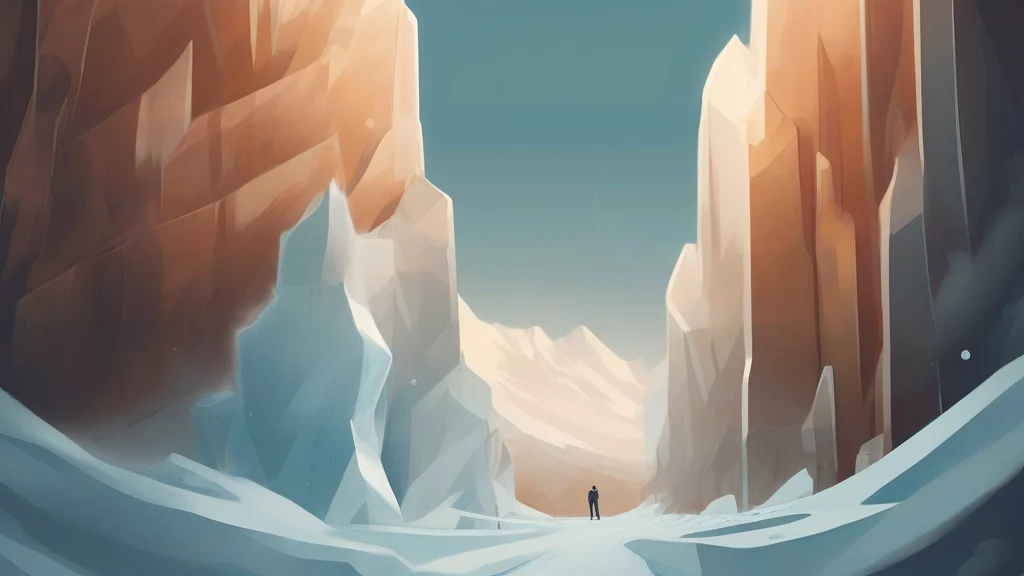
What does glaciate mean?
Glaciate is a formal verb meaning to cover something with ice or to become ice-covered. In geography and environmental writing, it describes the action of glaciers as they spread ice across land and gradually reshape it. The related adjective “glaciated” is commonly used for terrain covered by ice or affected by glacial processes. Because the term is specialized and relatively uncommon, it appears mainly in discussions of glaciated landscapes, climates, and periods rather than in everyday speech. Its implications are usually extensive and enduring: a glaciated region is not simply cold but has been transformed by persistent ice. The word offers a precise way to describe the action of freezing or being covered with ice while remaining distinct from the general condition of being cold. It belongs to the same Latin-derived family as glacier, glacial, glaciologist, glaciologist, and glaciation.
verbTo cover something with ice, or to become covered with ice or frozen. The word is especially used for the action of glacial ice on landscapes.
- To cover an area or surface with ice or glacial ice.
- To become covered with ice or frozen.
"Glaciers gradually glaciate and reshape the valleys through which they move."
"Expanding ice sheets glaciate the land and alter its drainage systems."
"The shallow lake will glaciate if it remains below freezing for long enough."
To glaciate is to let ice take over a landscape—slowly, massively, and for thousands of years.
Reviewed by Deb Chak, Editor. AI-assisted content curated by RJS Tech Solutions LLP.
Where does glaciate come from?
The English verb comes from Latin glaciare, meaning “to turn into ice” or “to make icy,” formed from glacies, “ice” or “snow.” Related English words such as glacier and glacial developed from the same Latin root, in some cases through French. The later noun glaciation and participial adjective glaciated continue the same etymological family.
Related word forms
How glaciate is actually used
This is a formal and relatively uncommon word, found chiefly in geographical, geological, and environmental contexts. The transitive form is more common than the intransitive form, and it is frequently encountered in the participial form “glaciated.”
Easily confused with glaciate
Glacial is an adjective relating to glaciers or glacial processes, whereas glaciate is a verb describing the covering of something with ice.
A glacier is a noun for a large mass of moving ice, while glaciate is the verb for the process of becoming or making ice-covered.