
What does globe mean?
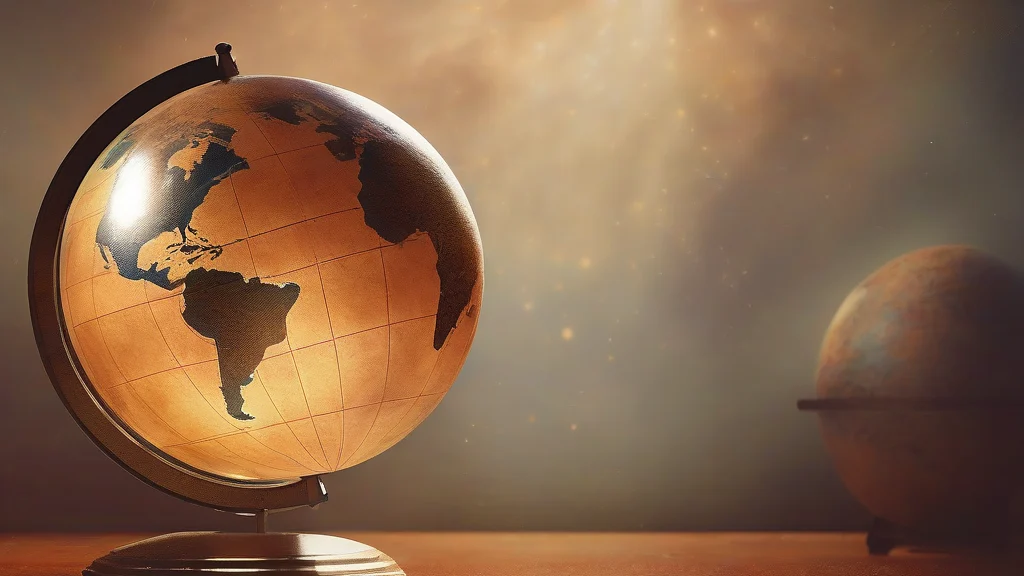
A globe is, literally, a spherical representation of Earth on which places and other features are shown. The term can also refer to a celestial sphere and, in literary or formal contexts, to the world or a defined political world, as in “the diplomatic globe.” A globe is more specific than the general word sphere and usually implies Earth, while world more often emphasizes human society, geography, or experience. The verb to globe is comparatively uncommon: it can mean to shape something into a spherical form or to make something known worldwide. In ordinary modern use, the noun dominates. The word's Latin ancestry explains both its physical and figurative uses: Latin globus meant “ball or sphere,” while forms such as global and globular developed from the same root. Its history therefore spans everything from a tangible model of the planet to a broad synonym for the world.
A spherical model or representation of Earth; by extension, a celestial sphere, the world, or a particular sphere of human activity.
"A brass globe stood on a wooden stand beside the old atlas."
The physical object and the figurative sense share the same word, so context usually determines which is intended.
To shape into a sphere, or to make or become known throughout the world.
"The artist globed the clay into a smooth, perfect sphere."
This verb is much less common than the noun and is chiefly literary or specialized.
The standard plural is globes, used for spherical models, celestial globes, and figurative spheres of activity.
"The classroom displays globes showing the continents and major oceans."
The word globe began as a general term for a ball or sphere, then narrowed to Earth before expanding to mean the whole world.
Reviewed by Deb Chak, Editor. AI-assisted content curated by RJS Tech Solutions LLP.
Where does globe come from?
The English word comes through Middle English globe from Old French globe, a borrowing of Latin globus, meaning “globe, ball, or sphere.” Latin globus was productive in related forms such as globulus, the diminutive from which globule developed. Early English uses developed from a general sense of sphere toward the now-dominant senses of a model of Earth and, figuratively, the world; closely related English words include global, globular, and globule.
Related word forms
How globe is actually used
The noun is standard in general English, with globe-trotting and the verb often carrying a literary, dated, or specialized tone. In figurative use, globe tends to suggest the world as a rounded whole or a defined sphere of human activity.
Easily confused with globe
A globe is a noun naming a spherical model or, figuratively, the world, while global is an adjective describing something involving the whole world.