
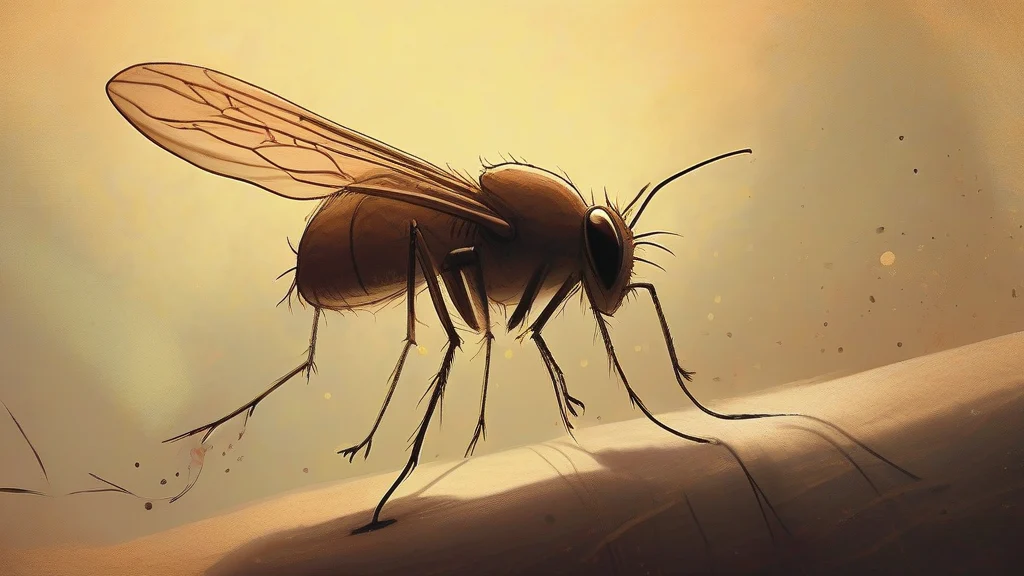
What does gnat mean?
A gnat is a very small fly, particularly a tiny biting fly of the kind commonly called a midge. In British and American English, the word often appears in descriptions of irritation, swarms, and outdoor discomfort, although it can also refer to small flies that do not bite. A single insect may be difficult to ignore because its buzzing and persistent movement draw attention, while a group can make a garden, picnic, or evening walk unpleasant. The term is occasionally used figuratively for something tiny or insignificant, but its literal sense remains much more common. It is pronounced /næt/, with the initial g silent. Compared with the more familiar mosquito, a gnat is generally associated with a smaller-bodied fly, especially a midge, though the two words are sometimes used loosely together. The word is useful because it identifies a familiar tiny insect without implying that every species within the broad group behaves in the same way.
nounA gnat is a very small fly, especially one of the small biting flies such as a midge. The term can also refer more broadly to tiny flies that do not bite.
- A very small fly, particularly a biting midge; more broadly, any of various small flies.
"A determined gnat circled my head until I went indoors."
"A gnat landed on my arm and left an unexpectedly itchy welt."
"The path beyond the barn was thick with gnats after sunset."
The standard plural adds -s and is used for individual insects as well as collectively for a swarm.
"Several gnats followed us along the trail."
Tiny enough to overlook, but troublesome enough to ruin a picnic when they swarm.
Reviewed by Deb Chak, Editor. AI-assisted content curated by RJS Tech Solutions LLP.
Etymology of gnat
The word descends from Old English gnætt, an older form recorded for a small fly or insect. It continued in Middle English as gnat, and related forms appear in other Germanic languages, including Old Norse gnátt and Old High German gnatz. These parallels point to a shared Germanic origin.
How gnat is actually used
This is a neutral, everyday noun. It is pronounced /næt/, with no separate /g/ sound. In nontechnical use, the word often suggests a small fly that bites, although some kinds of gnats do not.
Easily confused with gnat
A knot is a loop or fastening in rope, whereas a gnat is a small fly.