
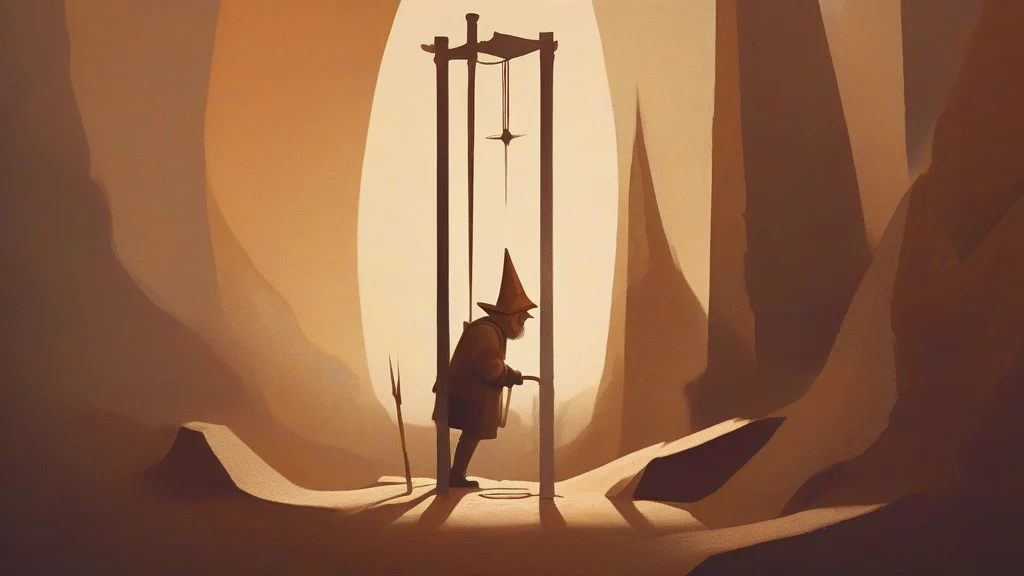
What does gnomon mean?
A gnomon is the shadow-casting part of a sundial. Its edge serves as a moving hand: as the Sun changes position, the shadow it produces crosses the dial's hour markings. The word also has a specialized geometric meaning, referring to a line segment extending from the center of a circle to its circumference, traditionally accompanied by a perpendicular segment to a tangent. A gnomon is therefore not simply any sundial component but the particular piece that casts the indicating shadow. The term is uncommon in everyday speech but familiar in discussions of sundials, timekeeping, astronomy, surveying, and the history of geometry. Its scientific associations give it an exacting, specialist character. The word ultimately comes from Ancient Greek, where it referred both to a means of recognition and to a pointer, linking its modern sundial sense to the broader idea of something that reveals information.
nounA gnomon is the shadow-casting pointer of a sundial, whose shadow indicates the time. In geometry, a gnomon is a line segment extending from the center of a circle to its circumference, traditionally accompanied by a perpendicular segment to the tangent.
- The pointer or blade of a sundial that casts a shadow to indicate the time.
- A geometric line segment from the center of a circle to its circumference, traditionally used with a perpendicular segment extending to a tangent.
"The gnomon cast a precise shadow across the sundial, marking the hour."
"At noon, the tip of the gnomon's shadow fell exactly on the twelve-o'clock mark."
"The geometrician used the gnomon to construct and measure angles inscribed in the circle."
The standard plural for multiple sundial pointers or geometric line segments of this type.
"The exhibition displayed several sundials with ornate brass gnomons."
A gnomon turns the Sun's shadow into a clock.
Reviewed by Deb Chak, Editor. AI-assisted content curated by RJS Tech Solutions LLP.
Etymology of gnomon
The word derives from Ancient Greek γνώμων (gnṓmōn), meaning “one who knows,” “pointer,” or “index,” from the verb γιγνώσκω (gignṓskō), “to know.” In Greek mathematical and astronomical contexts, the term came to designate an indicator or pointer, including the part of a sundial that casts a shadow. English borrowed it for sundials and geometry; its English cognates include words such as gnome, gnosis, and gnostic, which reflect the same root's association with knowledge.
Related word forms
How gnomon is actually used
The word is relatively uncommon in general conversation but is standard in astronomy, sundial-making, surveying, and classical or Renaissance geometry. Its plural is used in the same way as the singular.
Easily confused with gnomon
A gnomon is a sundial pointer or a geometric line segment, whereas a gnome is chiefly a small mythical being or, informally, an expert in a specialized subject.