
What does gonfalon mean?
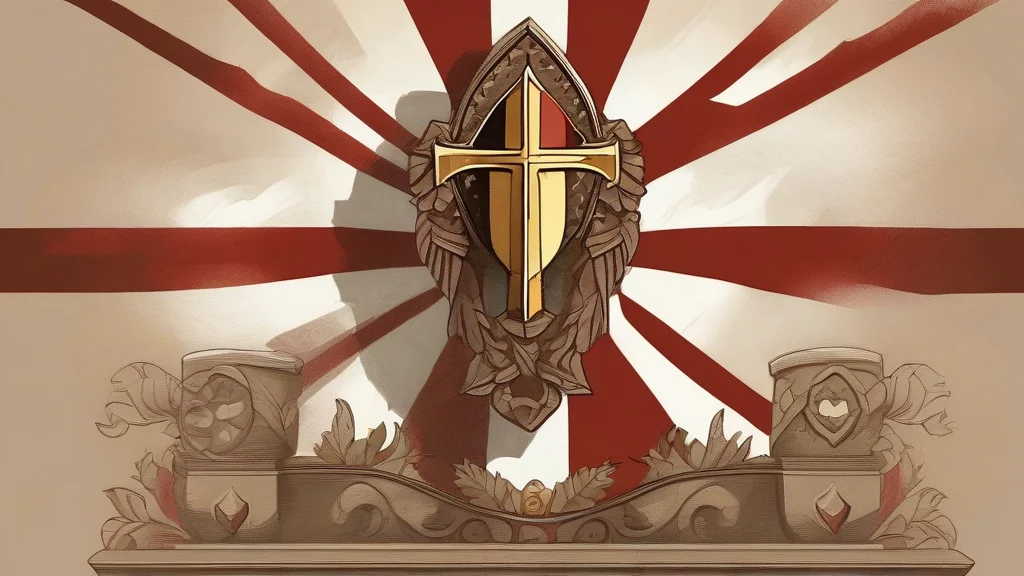
A gonfalon is a ceremonial or heraldic banner that normally hangs from a horizontal crosspiece rather than extending outward from a vertical flagpole. Such banners often bear decorative devices, embroidery, or streamers and can have a distinctive shape at the lower edge. Historically, gonfalons served as standards for guilds, civic authorities, religious institutions, and military or ceremonial bodies, often appearing in processions or as signs of collective identity. The word therefore carries associations with ceremony, history, craftsmanship, and public display, and it is generally more specialized than the everyday word flag. Although its present form is gonfalon, the older variant gonfanon survives in historical and heraldic contexts. The term is useful when describing a banner specifically intended to hang or be formally displayed, especially where its ceremonial role or distinctive shape matters.
nounA gonfalon is a hanging banner, typically suspended from a horizontal crosspiece and often decorated with streamers. It was especially associated with processions, guilds, civic bodies, and religious or military ceremonies.
- A hanging banner or standard, especially one carried in a procession or displayed by a guild, civic organization, church, or military body.
"The guild's richly embroidered gonfalon led the procession through the city."
"The old civic guild preserved its embroidered gonfalon as a symbol of municipal identity."
"At the coronation, a velvet gonfalon was carried before the assembled representatives of the city."
The standard plural is gonfalons.
"Several colorful gonfalons appeared in the ceremonial procession."
A gonfalon does not simply wave from a pole: it hangs from a crosspiece, making it a banner made for display and procession.
Reviewed by Deb Chak, Editor. AI-assisted content curated by RJS Tech Solutions LLP.
Where does gonfalon come from?
The English word came through Old French gonfalon, which was borrowed from Old Italian gonfalone. Medieval Latin gonfalonem also appears in the chain of borrowing, and related older forms include the English gonfanon and confanon. These European forms developed through medieval usage, where they referred to banners or standards associated with processions and organized bodies.
How gonfalon is actually used
Gonfalon is chiefly a formal, historical, heraldic, or literary term. In ordinary modern use, flag or banner is usually more natural.
Easily confused with gonfalon
Gonfanon is an older variant spelling of the same word for a hanging or processional banner, while gonfalon is the usual modern form.