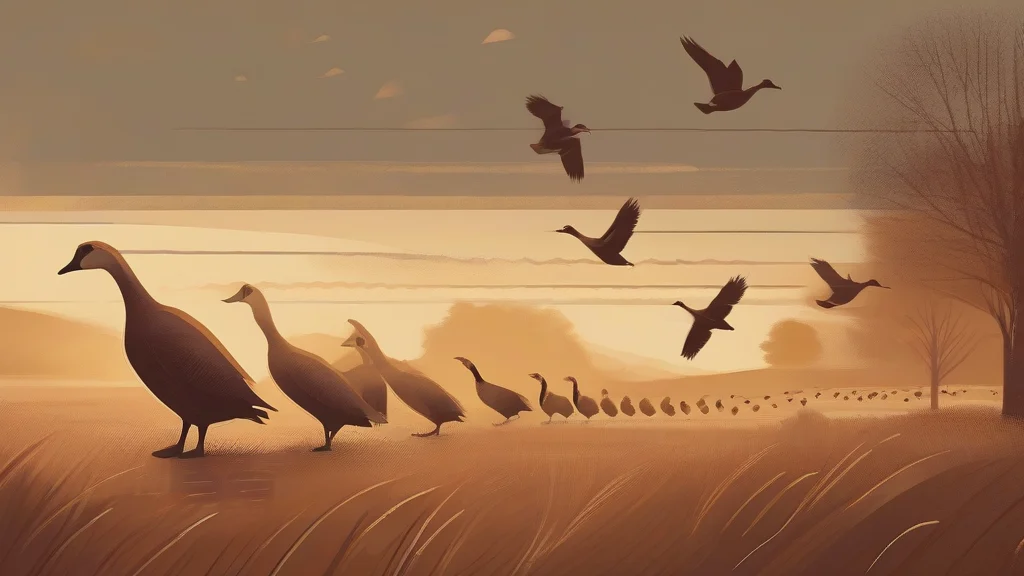
What does gooseherd mean?
A gooseherd is a person responsible for the care and management of geese, typically on a farm or in a field. This occupation involves ensuring the geese have adequate food, water, and shelter, as well as protecting them from predators and disease. The term 'gooseherd' is often used in rural or agricultural contexts, and is closely related to other occupations such as shepherding or cattle herding. While not as widely recognized as some other animal care professions, the role of the gooseherd is essential for maintaining healthy and thriving flocks of geese. Historically, gooseherds were often children or young adults tasked with watching over the geese in pastures or fields.
nounA person who takes care of geese, especially one who tends them on a farm or in a field.
- A person who takes care of geese.
- A person who tends geese on a farm or in a field.
"The gooseherd led the flock of geese through the green pasture."
"The gooseherd led the flock of geese through the green pasture."
"The farmer hired a gooseherd to watch over his geese during the summer."
The plural form 'gooseherds' is used to refer to multiple individuals who tend geese.
"The farm hired several gooseherds to watch over their large flock of geese."
Reviewed by Deb Chak, Editor. AI-assisted content curated by RJS Tech Solutions LLP.
Etymology of gooseherd
The term 'gooseherd' has its roots in Old English and Germanic languages. It is derived from 'goose' and 'herd', which refers to a person who tends or manages a group of animals. The word 'gooseherd' has been in use since at least the 15th century, and is closely related to other terms such as 'shepherd' and 'cowherd'.
How gooseherd is actually used
The term 'gooseherd' is often used interchangeably with 'gooseherder', although 'gooseherder' may also refer to a machine or device used to manage geese.