
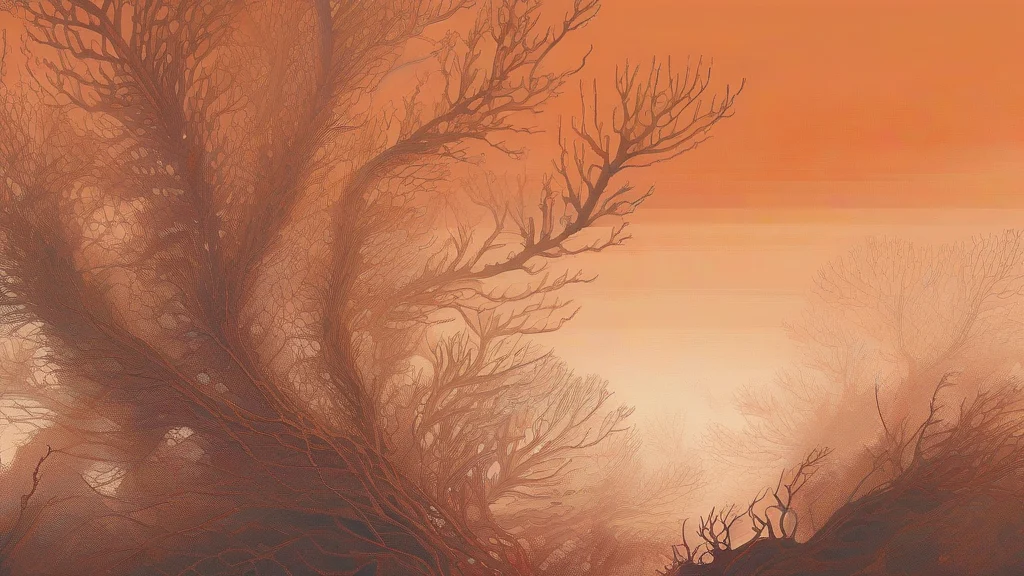
What does gorgonian mean?
“Gorgonian” is chiefly an adjective describing something associated with the Gorgons, the terrifying female monsters of Greek mythology. It is especially associated with Medusa, whose gaze could turn people to stone, and can suggest a frightening appearance or a petrifying effect. The word also functions as a noun for a Gorgon. In a separate zoological sense, gorgonian refers to soft corals of the genus Gorgonia, many of which have branching or fan-like forms. Thus, the term can evoke either ancient myth or the appearance of marine invertebrates. It is not an everyday word, but it is useful when discussing classical art and literature, fantasy, symbolism, or coral biology. Its mythological sense is generally more familiar than its scientific one, and capitalization varies with context: Gorgonian may be capitalized when referring directly to the mythical beings, while lowercase is usual in descriptive or zoological contexts.
Of, relating to, or resembling a Gorgon, especially Medusa; also, in zoology, relating to soft corals of the genus Gorgonia.
"The artist's use of Gorgonian imagery gives the figure a wild, supernatural power."
The mythological use is literary or specialized. The zoological use is technical and usually lowercase.
A Gorgon, especially Medusa; also a soft coral belonging to the genus Gorgonia.
"Medusa, the most famous gorgonian, is commonly represented with snakes in her hair."
The mythological noun is uncommon outside literary, artistic, and mythological contexts.
The regular plural is used for multiple Gorgons and, in zoological writing, for multiple corals of the genus Gorgonia.
"The gorgonians of Greek myth were commonly described as hideous beings with snakes for hair."
Gorgonian carries two contrasting worlds: the petrifying gaze of Greek myth and the delicate fan-shaped soft corals of the genus Gorgonia.
Reviewed by Deb Chak, Editor. AI-assisted content curated by RJS Tech Solutions LLP.
Etymology of gorgonian
The English word comes through Latin gorgonianus, a form derived from Greek Gorgṓn, the name for the Gorgons. The same Greek source also underlies Gorgon and the zoological names Gorgonia and Gorgoniidae. The word was historically used for beings resembling or belonging to the family of the Gorgons before acquiring its coral-related scientific sense.
How gorgonian is actually used
The mythological sense is literary, historical, or specialized and may be treated as grand or dramatic. In zoological usage, the word is technical; the genus name Gorgonia is capitalized, while the common term gorgonian is normally lowercase.
Easily confused with gorgonian
A Gorgon is one of the monsters of Greek mythology, while gorgonian is the derived adjective and also a noun used for such a monster or a coral of the genus Gorgonia.