
What does gorgon mean?
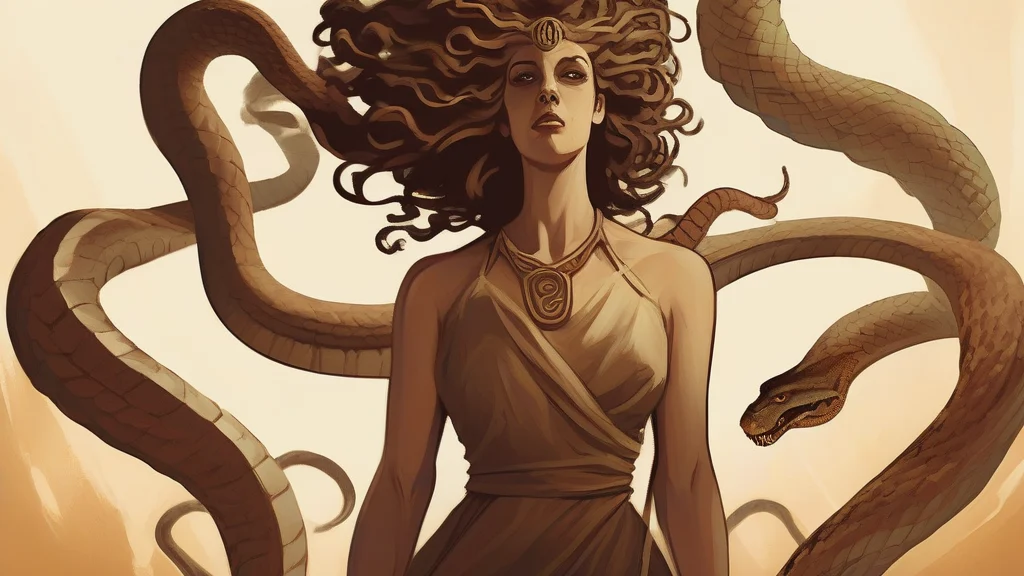
A gorgon is a female monster from Greek mythology, best known for snakes in its hair and a gaze that turns people to stone. Medusa is the most famous example, alongside her sisters Stheno and Euryale, who together formed the traditional group known as the Gorgons. In ordinary language, “gorgon” can also describe a frightening or formidable woman, usually in a dramatic or humorous register. The word evokes stares of supernatural terror and forces someone else to confront that power. Although stories differ in their details, the gorgon’s defining traits are consistently monstrous appearance and deadly power. The term is most often encountered in discussions of classical mythology, retellings of the Perseus story, and figurative descriptions of intimidating people.
nounIn Greek mythology, a gorgon is a female monster, usually depicted with snakes for hair, whose gaze turns people to stone. The term may also be used figuratively for a frightening or formidable woman.
- A female monster of Greek mythology, typically with snakes for hair and the power to turn observers to stone.
- Figuratively, a frightening, intimidating, or formidable woman.
"The hero overcame the gorgon by turning his face away and looking only at her reflection."
"Medusa was the most famous of the gorgons, whose gaze turned people to stone."
"She was a true gorgon in the courtroom, intimidating every witness who took the stand."
The usual plural is “gorgons”; the mythological group is commonly called “the Gorgons” and is usually capitalized.
"Stories of the Gorgons have inspired countless paintings, poems, and films."
Medusa's snakes were hair-raising, but her dangerous power came from simply being seen.
Reviewed by Deb Chak, Editor. AI-assisted content curated by RJS Tech Solutions LLP.
Where does gorgon come from?
The English word comes through Latin from Greek gorgṓn, a term for a mythological monster. Greek gorgṓn is generally connected with gorgós, an adjective meaning growling or roaring, reflecting the threatening character of these creatures. Its established English sense developed through classical mythology and later literary retellings.
How gorgon is actually used
Capitalize “Gorgon” when referring to a named mythological figure or the traditional group of Gorgons; lowercase it for a generic member of that group or for the figurative sense. The figurative use can sound literary, dramatic, or occasionally humorous, and may imply fear rather than mere strictness.