
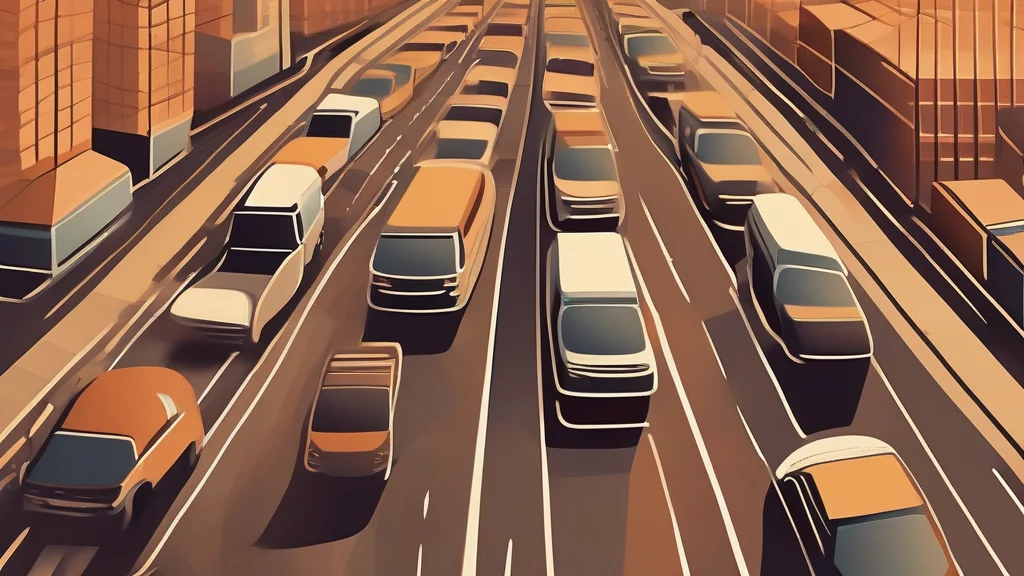
What does gridlocked mean?
Gridlocked describes a situation in which movement or progress has been brought completely to a halt by congestion, obstruction, or mutually incompatible actions. The word is most often used for roads filled by stationary vehicles, as in “traffic was gridlocked,” but it also applies figuratively to negotiations, teams, and systems that cannot proceed because each participant is waiting on or blocking another. Its strong image of an impassable mesh makes it more vivid than simply “jammed,” and it often conveys frustration, inefficiency, and a need for intervention. Although it began in traffic language, gridlocked is now common in British and American English for both literal and figurative deadlock. In careful writing, it works particularly well as a predicate adjective, such as “the motorway was gridlocked,” and can describe a group of people or activities rather than an object directly.
Completely immobilized or unable to move because of congestion, obstruction, or mutually blocking conditions.
"The downtown streets were gridlocked by rush-hour traffic."
The dominant modern use is predicative, especially after forms of be or after verbs such as become.
To become immobilized through congestion or obstruction, or to cause traffic or another process to become completely blocked.
"A burst pipe gridlocked traffic across the city."
This use is less frequent than the adjective and is most natural when describing the effect of an incident on traffic.
A road full of gridlocked traffic is one of the few everyday problems whose name sounds as tangled as it looks.
Reviewed by Deb Chak, Editor. AI-assisted content curated by RJS Tech Solutions LLP.
Where does gridlocked come from?
Gridlocked developed in early twentieth-century American English from gridlock, a compound formed from grid and lock; gridlock originally referred to traffic immobilized within a network of streets. The sense of grid ultimately derives from Latin craticula, meaning a small framework or lattice, which also lies behind griddle, gridiron, and graticule. The participial form gridlocked came to describe both congested traffic and, later, any situation in which participants block one another’s progress.
Related word forms
How gridlocked is actually used
The word is neutral in register and is common in both literal and figurative contexts. It often carries connotations of frustration, inefficiency, and a deadlock that requires outside intervention.
Easily confused with gridlocked
Gridlock is the noun naming the blocked condition or process, whereas gridlocked is chiefly an adjective describing the traffic, people, or situation that is affected by it.