
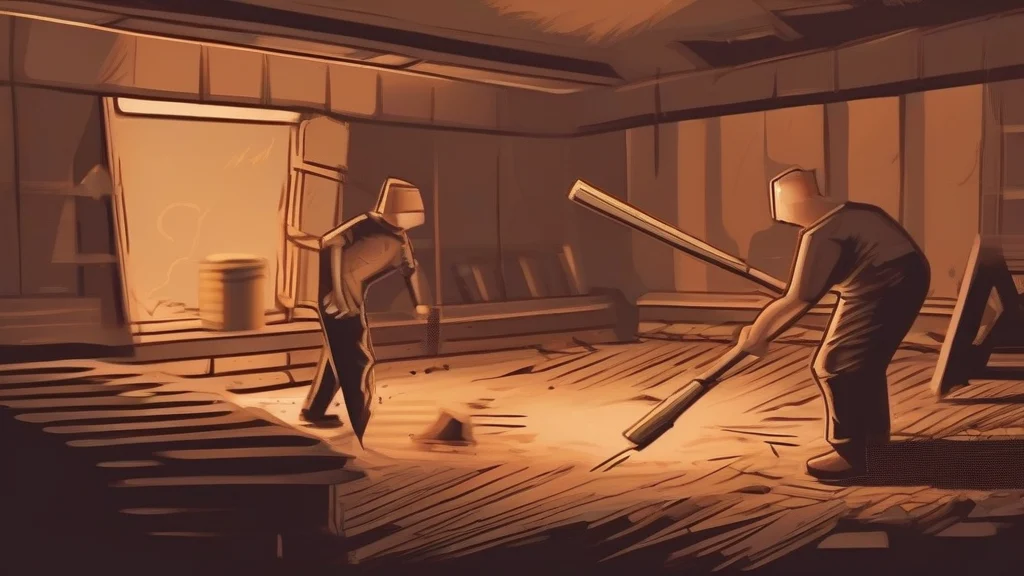
What does hammering mean?
Hammering is a common English word that can describe both literal activity and figurative intensity. In its most direct sense, it means striking something repeatedly with a hammer, often to flatten, shape, drive, or secure it. It can also refer to a forceful repeated sound, as when rain hammers a roof or a fist hammers on a door. In extended use, 'hammering away at' a problem or task means working on it persistently and with great effort, while 'a hammering' can describe a severe beating or defeat. As a present participle, hammering gives an action an immediate sense of force, rhythm, and energy. The word is used in both formal and informal contexts, although figurative expressions can sound aggressive when they describe criticism or intense pressure. Its usefulness lies in this combination of physical clarity and metaphorical force: it turns an ordinary repeated action into a vivid picture of persistence, impact, or hard work.
To strike repeatedly with a hammer; to make a forceful repeated sound; or to work hard and persistently at a task.
"He hammered the stake deeper into the soil."
The form can function as a present participle in progressive constructions or as a gerund before a noun.
The act or sound of hammering; a period of forceful, persistent work; or, informally, a severe beating.
"The hammering from the workshop continued late into the evening."
The noun is usually uncountable when referring to an activity or sound. The countable plural 'hammerings' is possible but uncommon.
The countable plural is possible but uncommon; the noun is usually uncountable in ordinary use.
"The report documented several separate hammerings of the metal casing."
Hammering is a present participle with a double life: it can describe a physical blow, a loud rhythm, or relentless effort at something difficult.
Reviewed by Deb Chak, Editor. AI-assisted content curated by RJS Tech Solutions LLP.
Where does hammering come from?
Hammering is formed in English from hammer by the regular present-participle and gerund ending -ing. The noun hammer comes from Old English hamor and is inherited from Germanic, with related forms in Dutch hamer and German Hammer. English later developed numerous derivatives from this base, including hammerhead, hammerer, and hammerless.
How hammering is actually used
Hammering is a present participle and verbal noun. Figurative uses, especially 'hammering away at something,' suggest sustained effort, persistence, and sometimes criticism or pressure. The noun 'a hammering' can mean a severe beating and is especially common in British and informal usage.