
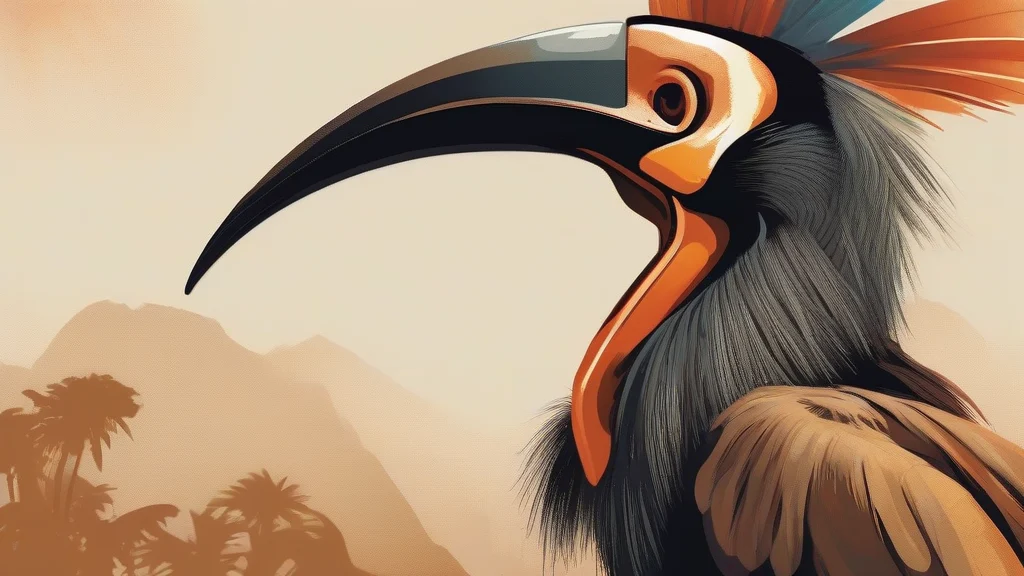
What does hornbill mean?
A hornbill is a large tropical bird, native to Africa and Asia, recognized by its unusually long bill, often surmounted by a prominent casque. The family Bucerotidae includes many colourful species, from the great hornbill to smaller, ground-dwelling African hornbills. Hornbills occupy varied habitats, including tropical forests and savannas, and feed on fruit, insects, small vertebrates, and other animals. Their nesting habits are especially distinctive: in many species, the female enters a tree cavity and is partly or completely enclosed by a wall of mud or excrement before laying her eggs. The male often feeds her through a narrow opening, and she remains in the cavity for much of the incubation and early chick-rearing period. Although hornbills are sometimes confused with toucans, the two groups belong to different bird families and occur on opposite sides of the Atlantic. The word is useful for identifying a highly recognizable group of birds and for discussions of tropical biodiversity and conservation.
nounAny of various large tropical birds with long, often curved bills, commonly topped by a casque. Hornbills are found mainly in Africa and Asia and are known for their distinctive nesting behaviour.
- A member of the bird family Bucerotidae, generally characterized by a large bill with a casque or other prominent structure.
"A hornbill perched at the edge of the forest, its enormous bill silhouetted against the morning sky."
"The great hornbill was carrying a small lizard in its bill."
"Conservation groups have warned that some hornbill populations are declining because of habitat loss and illegal trade."
The plural is formed by adding -s to the full word: one hornbill, two hornbills.
"Several hornbills gathered around a tree bearing fruit."
In many hornbill species, the female seals herself inside a tree cavity to lay her eggs, while the male supplies food until the chicks are old enough to leave.
Reviewed by Deb Chak, Editor. AI-assisted content curated by RJS Tech Solutions LLP.
Where does hornbill come from?
“Hornbill” is a compound formed in English from “horn” and “bill,” both elements referring to conspicuous features of the bird. “Horn” has Germanic roots and is related to words such as “corn” and “corner,” while “bill” in this sense derives from an Old English word for a beak or projecting mouthpart. The compound refers to the bird's bill and, in many species, the casque that rises above it.
How hornbill is actually used
The term is zoologically specific and normally refers to the bird itself, not to its bill or casque. In British usage, “hornbill” may be encountered more frequently in wildlife and conservation contexts; the spelling and pronunciation are otherwise consistent across major English varieties.
Easily confused with hornbill
Hornbills are Old World birds found in Africa and Asia, whereas toucans are New World birds found in Central and South America.
A hornbill is a bird, while a hornbill beetle is an insect belonging to a family characterized by a prominent snout.