
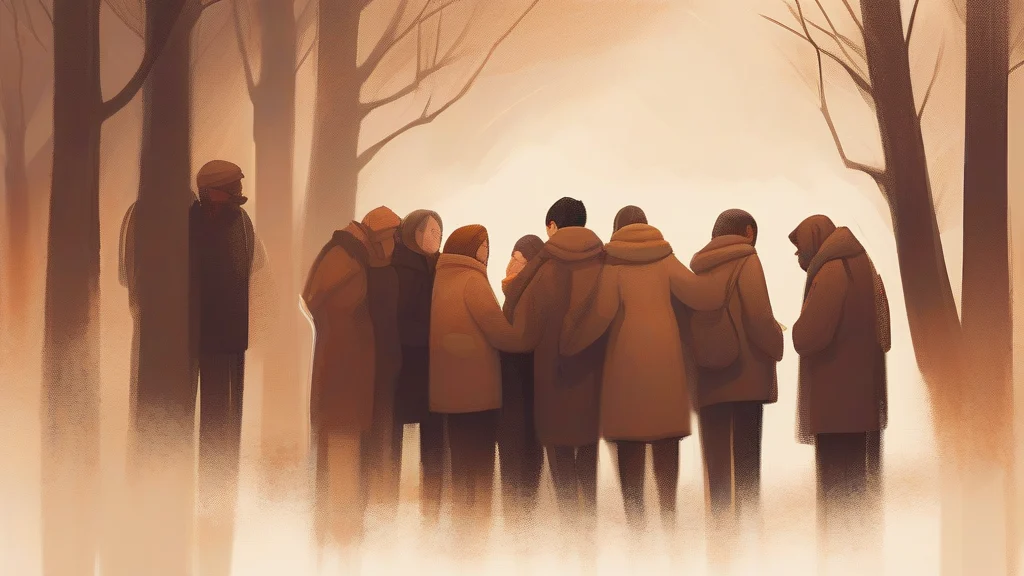
What does huddling mean?
Huddling means gathering or pressing closely together, usually because the people involved want warmth, comfort, privacy, or protection. It can describe a temporary action: a group may huddle under cover during a storm, crowd around a heater, or draw close to someone for reassurance. The word often suggests not only physical proximity but also a shared reaction, such as fear, discomfort, or the need for security. In figurative uses, people can huddle around an idea, a problem, or a decision, meaning to work on it collectively or focus closely on it. Huddling is especially natural in descriptions of people seeking warmth or shelter, but it can also refer to animals gathering closely together. The present participle form is common in both everyday speech and descriptive writing.
verbTo gather closely together, usually for warmth, comfort, protection, or a sense of security.
- To move or press close together as a group.
- To curl up or draw inward for warmth, comfort, or protection.
"The children huddled together beneath the blanket during the storm."
"The runners huddled beneath the awning while waiting for the storm to pass."
"She huddled under a thick blanket and listened to the wind outside."
Huddling turns a group of people into one compact unit, often for warmth, privacy, reassurance, or protection.
Reviewed by Deb Chak, Editor. AI-assisted content curated by RJS Tech Solutions LLP.
Where does huddling come from?
Huddling is formed from the verb huddle, with the present-participle ending -ing. The earlier origin of huddle is uncertain, and historical accounts differ about which related words may have influenced its development. Its modern senses are well established and focus on gathering closely together or drawing inward for comfort and protection.
How huddling is actually used
The word is commonly transitive or intransitive and conveys physical closeness, often with an emotional sense of security or anxiety. It is used in both formal and informal contexts.