
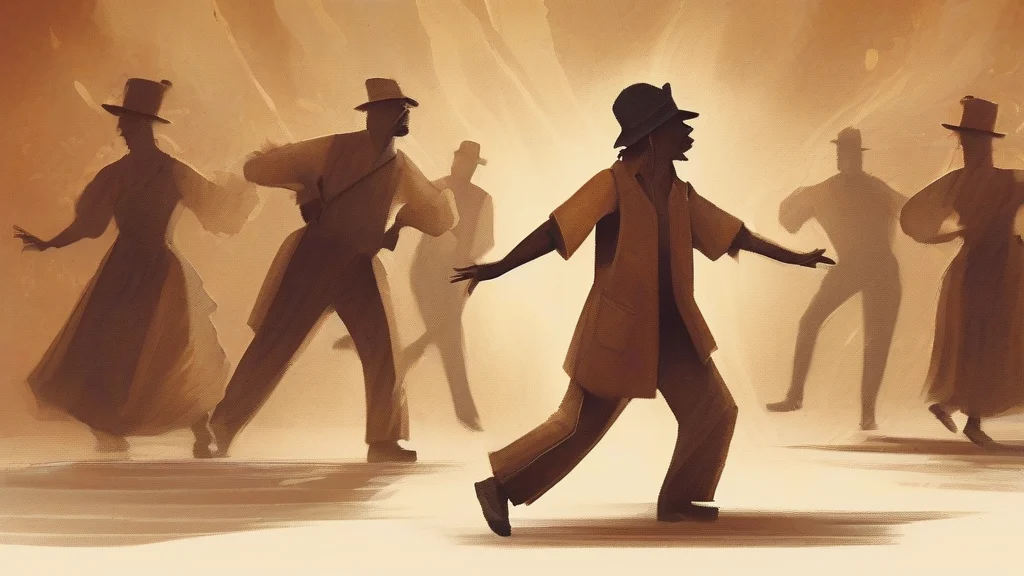
What does jig mean?
A jig is a quick, lively dance or step, most closely associated with Scottish and Irish traditional music, where it is often performed to a strongly accented instrumental tune. The word can also describe a brisk, jerky movement, as when an object jiggles because it is loose or being moved repeatedly. In British informal usage, a jig may be a trick, deception, or a story that distorts the truth. The verb jig means to move with such short, irregular motions and can carry a mildly dismissive or playful sense, suggesting aimless or exaggerated movement. Although jig and jiggle overlap in modern usage, jig often evokes a more deliberate or traditional movement, while jiggle suggests a looser, smaller motion. A jig is also the name of several practical objects, including a holder used during machining and a hook used in fishing.
A lively dance or step, especially one associated with Scottish or Irish traditional music; also a quick jerking movement, a deception, or a mechanical or fishing device.
"They danced a traditional jig at the village festival."
The dance sense is especially associated with British and Irish folk music. The deception sense is chiefly British and informal.
To move with quick, jerky or rocking motions.
"The toy jiggled across the floor as the child pulled its string."
Often used when something moves because it is loose, repeatedly pushed, or dancing energetically.
Used for individual dances, devices, or sets of fishing hooks.
"The band played three jigs before the interval."
The jig began as a shared cultural symbol of Scottish and Irish music, with its quick steps and buoyant rhythms surviving in traditions far beyond its homelands.
Reviewed by Deb Chak, Editor. AI-assisted content curated by RJS Tech Solutions LLP.
Where does jig come from?
The word appeared in Middle English in the sense of a lively dance or a jerking movement. It is generally connected with Middle French gigue and was also associated with gig, although the precise development through competing dance and musical terms is not entirely straightforward. The dance sense was later strongly influenced by Scottish and Irish musical traditions, while the verb developed from the idea of brisk, irregular movement.
Related word forms
How jig is actually used
The dance sense is especially associated with Scottish, Irish, and English folk traditions, although the word is used more broadly for a lively informal dance. The verb is common in both British and American English. In the sense of deception, the expression is chiefly British and informal.
Easily confused with jig
A jig is a traditional lively dance or a jerking movement, whereas a gig is principally a type of horse-drawn carriage or an informal performance.