
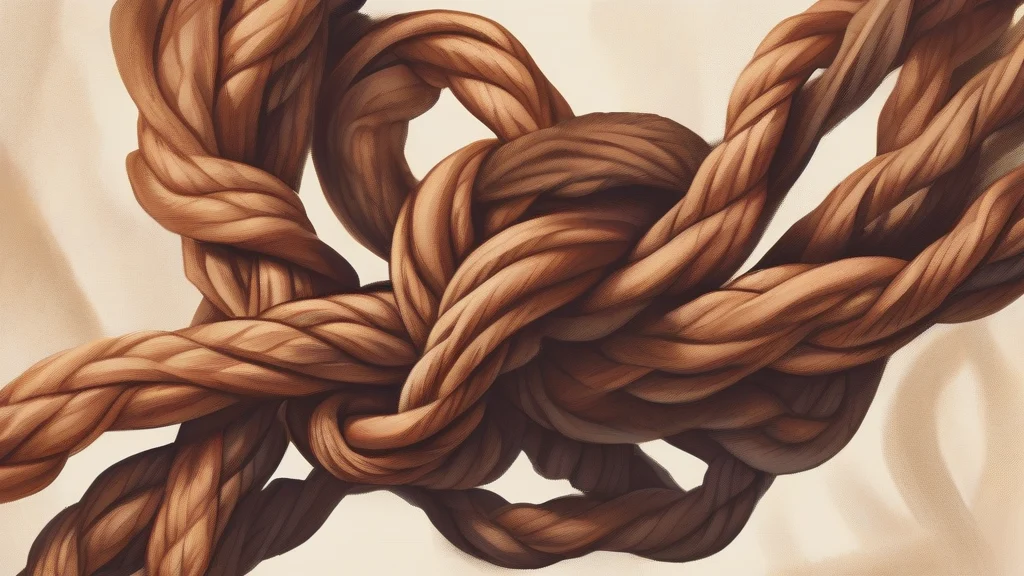
What does knotted mean?
“Knotted” describes something that has knots, twists, or tangles, especially a rope, tree, piece of wood, or mass of material. By extension, it can describe a problem, piece of writing, or situation that is intricate and difficult to understand or resolve. The word also applies to a person’s physical or emotional condition: a knotted stomach suggests anxiety or discomfort, while knotted nerves suggest intense anxiety or agitation. In these figurative uses, “knotted” conveys tightness, entanglement, and a lack of straightforward resolution. It is a familiar adjective in everyday English but can sound more vivid and literary than general alternatives such as “complicated” or “tense.” The word is especially common in descriptions of damaged ropes, tangled vegetation, difficult writing, and anxious physical reactions.
adjectiveHaving knots or tangles; difficult to untangle or understand. It can also describe a person's emotional or bodily state as tightly tense or contorted.
- Having knots, tangles, or twists.
- Formed into a tangled or complicated mass.
- Emotionally or physically tense, contorted, or difficult to untangle.
"After the storm, the crew worked to free the knotted ropes along the shore."
"The sail was so knotted that the sailors had to cut it free."
"She tried to remain calm, but her knotted nerves made every sound seem ominous."
A rope can be knotted, and a problem can feel knotted too: both are difficult to loosen.
Reviewed by Deb Chak, Editor. AI-assisted content curated by RJS Tech Solutions LLP.
Where does knotted come from?
The adjective “knotted” was formed by adding the participial ending -ed to the noun “knot.” “Knot” comes from Old English cnotta and ultimately from a Germanic root associated with a projecting mass or fastening. The related English adjective “knotty” shares the same origin and preserves the idea of something full of knots or difficulties.
How knotted is actually used
The adjective is common in both formal and informal contexts. Its figurative uses, especially for emotions, problems, or writing, convey tension and difficulty rather than merely physical tangles.
Easily confused with knotted
“Knotted” usually describes something physically tangled or figuratively complicated, while “knotty” more often means difficult, intricate, or full of knots.