
What does knuckle mean?
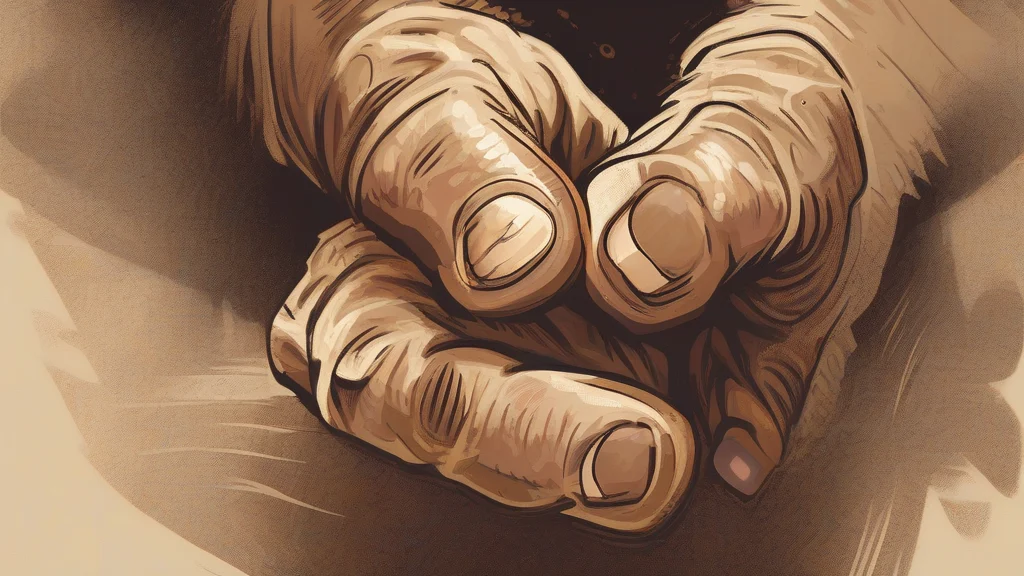
A knuckle is the joint at the base of a finger, especially the prominent part of the hand that becomes visible when the fingers are curled into a fist. The word can also refer to a similar rounded projection on another object. As a verb, “knuckle” means to bend the knuckles inward, often as a sign of discomfort, submission, or defeat. In the familiar phrasal verbs “knuckle down” and “knuckle under,” it describes either undertaking hard work with determination or yielding to pressure. The word is useful because it links a precise bodily feature to broader ideas of force, effort, endurance, and submission. In everyday speech, “knuckles” can evoke a sore hand, a clenched fist, or the physical discomfort associated with cold or prolonged effort.
A joint at the base of a finger, especially one visible when the hand is bent or clenched.
"A broken knuckle made it difficult to write."
To bend the knuckles inward; in some contexts, to submit or yield under pressure.
"He refused to knuckle to their demands."
The plural is used when referring to the finger joints collectively, as in “white knuckles” or “the knuckles of a hand.”
"Her knuckles were white as she held on tightly."
Knuckles are the body's tiny joints, but “knuckling under” has turned a physical bend into a vivid metaphor for giving in.
Reviewed by Deb Chak, Editor. AI-assisted content curated by RJS Tech Solutions LLP.
Where does knuckle come from?
The word comes from Middle English “knokel,” related to Old English “cnucel,” a diminutive of “cnuc,” meaning “knuckle” or “knob.” These forms continue an older Germanic root associated with a bony projection and the action of bending. The word has close cognates in German “Knöchel” and Dutch “knokkel.” The verb meaning “to submit” developed from the earlier physical sense of lowering or bending the knuckles as a gesture of submission.
Related word forms
How knuckle is actually used
In the expression “knuckle down,” the word means to begin working hard and persistently. “Knuckle under” means to submit or give way to pressure, while the standalone verb “knuckle” is less common and can sound old-fashioned.