
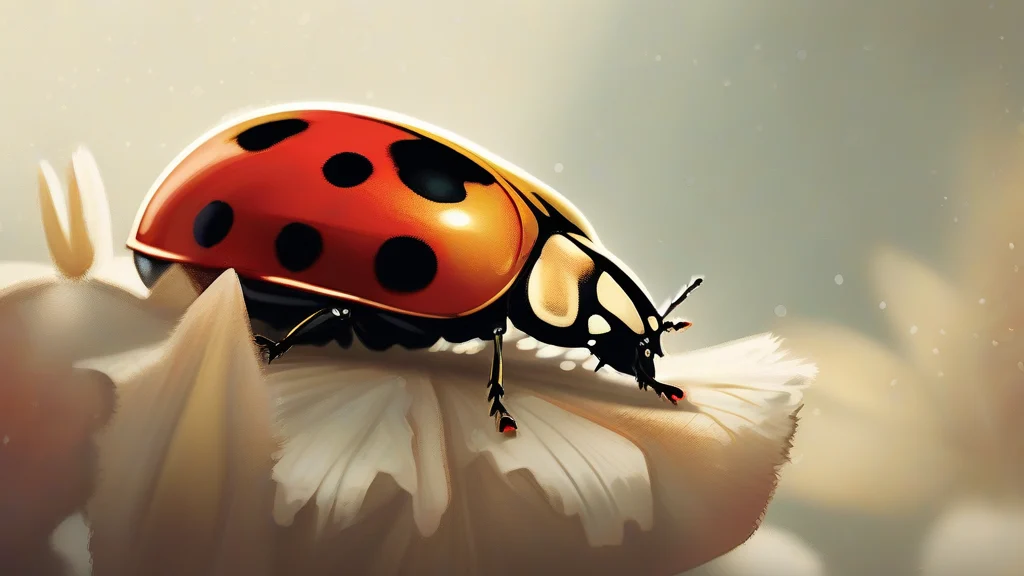
What does ladybird mean?
A ladybird is a small beetle, most commonly recognized by its rounded body and red or orange wing cases marked with black spots. In British English, "ladybird" is the standard everyday word; North American speakers usually say "ladybug," although both terms are widely understood. The name is traditionally linked to the Virgin Mary: the insect was sometimes called "Our Lady's bird," perhaps because its red color was associated with the Virgin's clothing or with the color traditionally used in representations of her. Although many species are red, ladybirds can also be black, yellow, orange, or patterned in other ways. The word is commonly used in educational, literary, and natural-history contexts, including children's books and informal descriptions of a beetle appearing in a garden or on a window. "Ladybird beetle" is also available when a more formal name is preferred.
nounA small beetle, typically bright red or orange with black spots. The term is the traditional British name for the insect commonly called a ladybug in North America.
- A small beetle, typically red or orange with black spots, belonging to the ladybird beetle family.
"A ladybird landed on the garden leaf."
"Children watched the ladybird crawl across the windowsill."
"The entomologist photographed a rare species of ladybird in the meadow."
The standard plural is "ladybirds" in British English; "ladybirds" or "ladybugs" may also occur in North American English.
"Several ladybirds were resting on the nettles."
Why call a beetle a "bird"? The name is traditionally explained as an old devotional reference to the Virgin Mary, or "Our Lady," whose color is associated with the insect's red markings.
Reviewed by Deb Chak, Editor. AI-assisted content curated by RJS Tech Solutions LLP.
Etymology of ladybird
The compound "ladybird" has been used in English since the 17th century, though the precise reason for the name is not certain. A traditional explanation connects it with the Virgin Mary, with "Our Lady's bird" referring to a beetle whose red coloring was associated with her. The insect also has relatives among the coccinellid beetles, including the closely related North American term "ladybug," while the modern biological name "ladybird beetle" reflects the insect's taxonomic group.
How ladybird is actually used
In British English, "ladybird" is the ordinary everyday term; "ladybug" is also understood in Britain, especially in informal or cross-cultural contexts. "Ladybird beetle" is a more formal or taxonomic alternative.
Easily confused with ladybird
"Ladybird" is the usual British term, while "ladybug" is the standard North American term for the same insect.