
What does lime mean?
“Lime” most commonly names a small, tart citrus fruit with green or yellow-green skin, used in drinks, cooking, and food preservation. It can also refer to the tree that produces the fruit and, in a separate sense, to a bright yellow-green color. In technical contexts, lime means calcium hydroxide, a white alkaline substance historically used in plaster, mortar, and soil treatment. The word's several meanings come partly from its long history in English: the fruit entered through the language of citrus cultivation, while the chemical sense developed from the use of lime in building and industry. The chemical and fruit senses are etymologically unrelated, which makes “lime” an unusually useful example of how a single word can acquire distinct histories while retaining the same spelling.
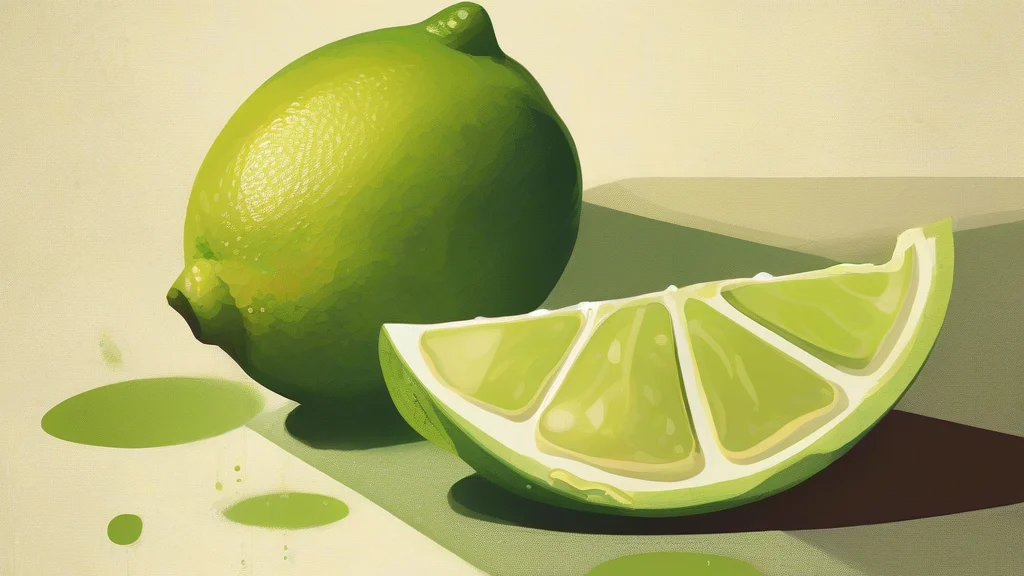
A small citrus fruit with tart juice and green or yellow-green skin; also the tree that bears it.
"He added lime juice to her sparkling water."
The fruit is widely used in cooking and drinks; “lime” can also refer to the tree.
Calcium hydroxide, a white alkaline substance used in plaster, mortar, and soil treatment.
"The builders mixed lime into the mortar."
This is a technical or historical sense; the related form quicklime refers to calcium oxide.
A bright yellow-green color.
"The door was painted a vivid lime."
This use is common in design, fashion, and descriptions of lights.
A green-yellow bird of the parrot family with a red beak.
"A lime flew onto the garden fence."
This zoological sense is standard particularly in British English.
Used for multiple limes or lime trees; the plural is also standard in chemical contexts when referring to quantities of lime.
"She bought a bag of limes for the cocktails."
The word “lime” names both a tart citrus fruit and the alkaline chemical used in lime plaster, an accidental collision of unrelated origins.
Reviewed by Deb Chak, Editor. AI-assisted content curated by RJS Tech Solutions LLP.
Where does lime come from?
The fruit sense of “lime” entered English in the early modern period through forms associated with Arabic and the cultivation of citrus fruits in the Mediterranean and Near East. The chemical sense comes from a different tradition: “lime” developed in relation to calcined limestone and lime-based building materials, ultimately reflecting Latin words connected with lime or mud. The bird called a lime has its own historical development and is not simply a modern descriptive use of the fruit name.
Related word forms
How lime is actually used
When referring to the fruit, “lime” is standard in both British and American English. The chemical sense is more technical and may refer specifically to calcium hydroxide, depending on context. In British English, “lime” is also a traditional term for the lime bird.
Easily confused with lime
A lime is generally smaller and has a green or yellow-green peel and a sharper, more tart flavor than a yellow lemon.
“Lime” refers to the citrus fruit, whereas “lemon” refers to the related yellow citrus fruit; the fixed expression uses both words as contrasting flavors.