
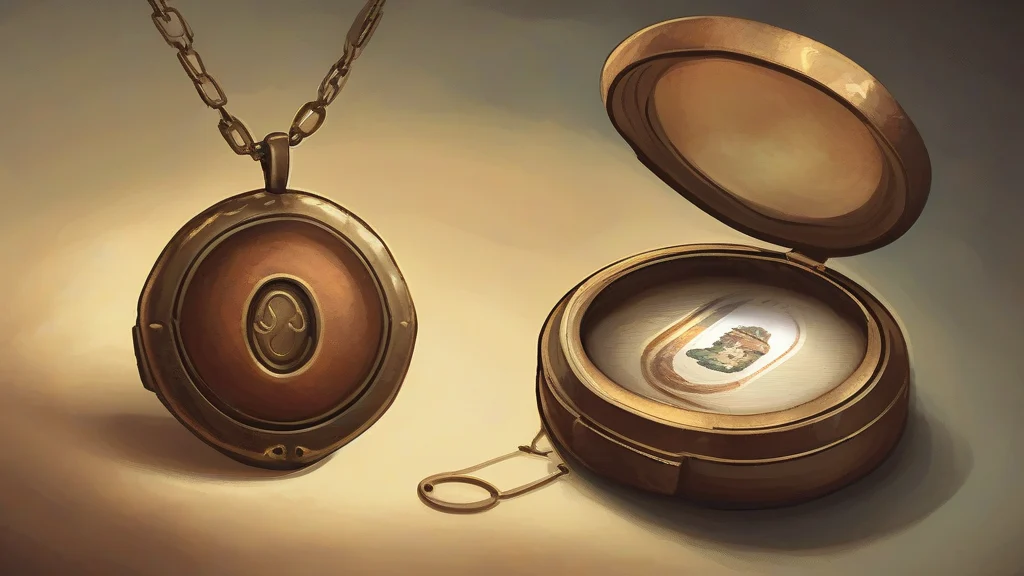
What does locket mean?
A locket is a small piece of jewelry, usually hinged and worn on a chain, that can hold a tiny photograph, a lock of hair, an inscription, or another keepsake. Its familiar modern use is sentimental: families and couples give lockets to preserve a person, memory, or message close to the heart. Historically, the word also referred to a lock or fastening, but that sense is now rare or archaic. A locket may be round, oval, heart-shaped, or decorative, and it may be engraved rather than compartmented. Unlike a generic pendant, which can be any hanging ornament, a locket is distinguished by its container-like function. The word is standard in British and American English and has gentle emotional associations without being limited to romantic relationships, since it can also commemorate family, friendship, travel, or a special event.
nounA small closable case worn as jewelry, usually suspended from a chain or necklace, and used to hold a photograph, lock of hair, inscription, or other keepsake. In older usage, the word also referred to a lock or fastening.
- A small hinged or closable jewelry case worn on a chain or necklace, commonly used to hold a photograph, lock of hair, inscription, or similar keepsake.
- Archaic: a lock, catch, or fastening.
"She opened the silver locket and found a miniature portrait of her grandmother."
"She opened the silver locket and found a miniature portrait of her grandmother."
"The engraved locket held a lock of hair from his wedding day."
The standard plural is formed by adding -s.
"The drawer contained several old lockets and pieces of jewellery."
A locket began as a piece of security—a tiny lock—before becoming a container for keeping memories close to the heart.
Reviewed by Deb Chak, Editor. AI-assisted content curated by RJS Tech Solutions LLP.
Where does locket come from?
The English noun appeared in the Middle English period as a borrowing from Anglo-Norman or Old French loquet, a diminutive of loc meaning a lock or fastening. The French form and English lock are commonly traced through Medieval Latin loca to Latin locus, meaning "place," although the precise historical connection is uncertain. Latin loculus, a diminutive of locus meaning a small place or cavity, provides a more remote comparison and is related to words such as locale and local.
Related word forms
How locket is actually used
The modern sense is neutral but often carries sentimental or affectionate associations. It is used in British and American English without a major regional distinction; the older sense meaning a lock or fastening is now archaic.