
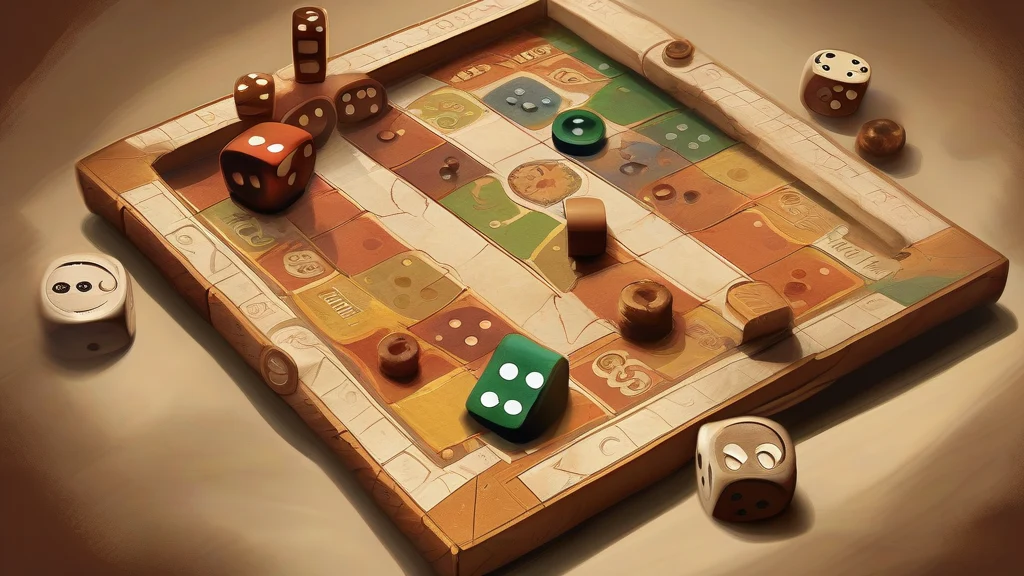
What does ludo mean?
Ludo is the name of a traditional board game played with counters, a die, and a cross-shaped board divided into coloured sections. Players move their pieces forward according to dice throws, bringing a piece into play and then moving it around the board; when a six is rolled, the player may also bring an additional piece into play. The objective is to race each opponent's pieces around the course and off the board. Ludo is especially associated with family and social play in South Asia, but versions and variations are also familiar in Africa, the Caribbean, and other parts of the world. Although its rules resemble those of several other racing games, ludo has become a distinctive and widely recognized name in its own right. The word entered English through British India and ultimately derives from Latin, linking this enduring global pastime to an ancient word for a public game or sport.
nounLudo is a board game in which players move counters around a cross-shaped board according to dice throws, removing a piece from the board when the corresponding number is rolled.
- A board game in which players race counters around a cross-shaped board, usually four in number, according to dice throws, with pieces entering and leaving the board as the relevant numbers are rolled.
"The family gathered around the table to play ludo after dinner."
"They played a lively game of ludo while waiting for the train."
"Ludo is especially popular at family gatherings in many parts of South Asia."
The plural is grammatically possible but is rarely needed in ordinary reference to the game.
"The tournament featured ludos in both the junior and senior divisions."
Ludo began as a game in British India, carrying a Latin name for play into a global pastime.
Reviewed by Deb Chak, Editor. AI-assisted content curated by RJS Tech Solutions LLP.
Where does ludo come from?
The English word came through British India in the 19th century, commonly through the Hindi form लूडो (lūḍō), which was used for the game. It ultimately derives from Latin lūdus, meaning “game” or “public game.” The same Latin root also lies behind English words such as ludic, ludicrous, and ludology.
How ludo is actually used
The term normally names the game as a whole, although the plural is occasionally used when referring to separate games or rounds. In British usage, the name often also denotes the physical board and game set.