
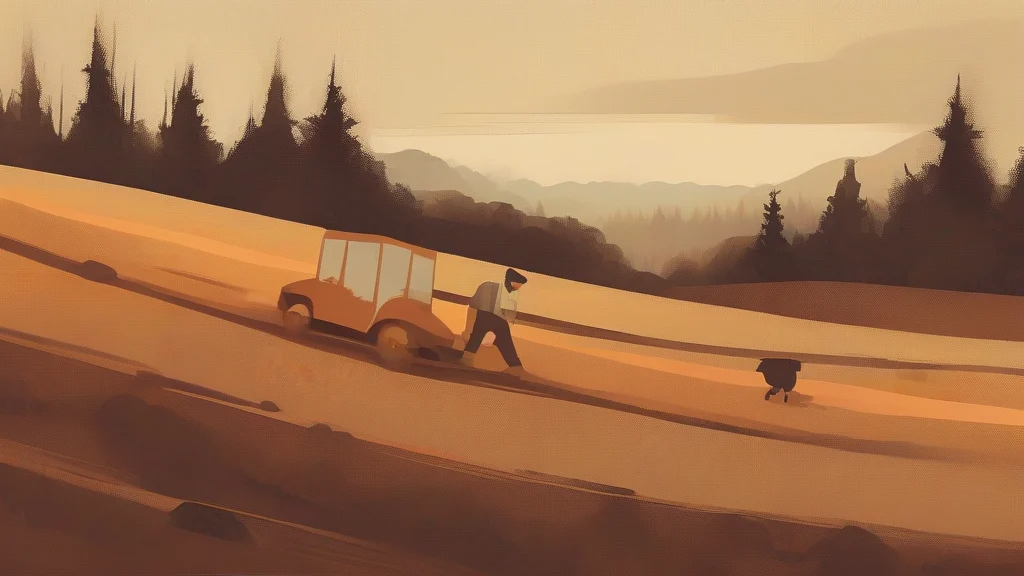
What does lumbering mean?
Lumbering describes movement that is heavy, awkward, and seemingly difficult to control, as in the lumbering gait of an animal or an old vehicle. Figuratively, it characterizes a process, institution, or change that advances slowly, awkwardly, and with little momentum. The word often conveys mild criticism: a lumbering bureaucracy may be too cumbersome to respond effectively, while lumbering progress suggests that reform is occurring but at an unhelpfully slow rate. In physical contexts, “lumbering” can describe anything whose movement seems ponderous rather than energetic, including ships, trucks, and tired animals. It is related to the verb “lumber,” meaning to move heavily or clumsily, and the suffix “-ing” gives the word both its conventional adjectival form and its present-participle use. Because the figurative sense draws directly on the image of slow, heavy movement, the word is especially effective when suggesting that something is not merely slow but burdened, resistant, or poorly managed.
Moving or proceeding in a heavy, awkward, slow, or unmanageable manner.
"The heavy machinery lumbered across the construction site."
The figurative use is often mildly critical and suggests cumbersome processes or ineffective progress.
Move heavily or clumsily; proceed slowly and with difficulty.
"The cargo ship lumbered slowly toward the harbour."
This is the present-participle form of “lumber” and can appear as a verb in continuous constructions.
Lumbering captures the double image of heavy, uneven footsteps and the slow, cumbersome pace of something struggling to move forward.
Reviewed by Deb Chak, Editor. AI-assisted content curated by RJS Tech Solutions LLP.
Where does lumbering come from?
“Lumbering” was formed from “lumber” and the present-participle suffix “-ing.” The origin of “lumber” is uncertain and is not securely traceable to a single source, although it came to refer to rough timber and, by extension, to bulky goods. Words such as “lumberjack” and “lumberyard” belong to the same modern derivational family, while the figurative sense of “lumbering” developed by analogy with slow, heavy physical movement.
How lumbering is actually used
The literal sense is usually physical, while the figurative sense is commonly critical of slow-moving institutions, outdated systems, or ineffective change. It can sound disparaging when applied to people, so descriptions of a person's gait should be used carefully.