
What does lung mean?
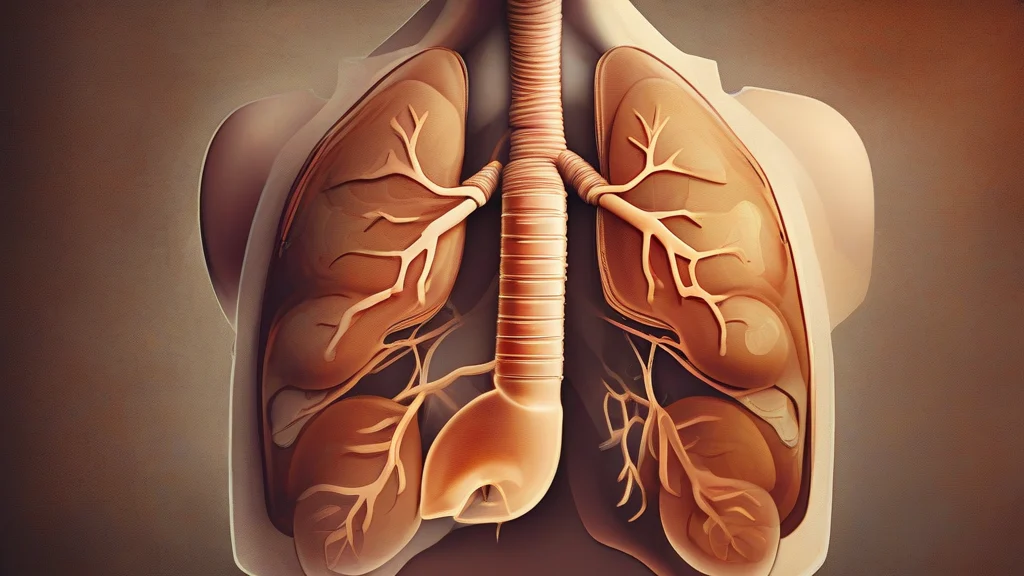
Lung names one of the two spongy organs found in the chest. Together, the lungs draw oxygen into the body and help expel carbon dioxide. Their many branching airways end in microscopic air sacs called alveoli, where oxygen and carbon dioxide pass between the air and the blood. The singular form is standard when one organ is meant, although lungs is overwhelmingly the usual form in ordinary speech, medical discussion, and expressions concerning breathing or respiratory health. Lung also functions as an uncommon verb meaning to breathe hard or with effort, as in lunging for breath after strenuous exercise. The word is direct and largely neutral, but discussions of damaged lungs, smoke inhalation, respiratory illness, and lung capacity can give it emotional weight because these subjects concern essential bodily functions. Figurative uses sometimes describe something that renews or sustains a person or place, though the anatomical sense remains dominant.
One of a pair of spongy, elastic organs in the chest that take in oxygen and remove carbon dioxide from the body.
"An examination revealed fluid around one of her lungs."
The usual plural is lungs; singular lung is standard when referring to one of the two organs.
To breathe with difficult, forced effort, especially after exertion.
"He was lunging for breath after the race."
This verb is uncommon and is mainly encountered in informal or older usage.
This is the standard plural form, used for the paired organs collectively or when discussing both lungs individually.
"Her lungs had grown stronger through regular exercise."
The lungs are the body's bellows: their branching airways deliver fresh air to millions of tiny exchange surfaces in a remarkably compact space.
Reviewed by Deb Chak, Editor. AI-assisted content curated by RJS Tech Solutions LLP.
Where does lung come from?
The English word lung descends from Old English lunge, meaning “lung,” and is cognate with forms in several Germanic languages, including Old Norse lunga and Dutch long. Its ultimate origin is uncertain, so proposed connections with Latin pulmo should be treated cautiously. The familiar derivatives pulmonary, pulmonic, and pulmonology are based on Latin pulmo, meaning “lung.”
Related word forms
How lung is actually used
In anatomical and general use, the singular lung refers to one organ, while lungs refers to both organs or to them collectively. The verb is relatively uncommon and has an informal or dated quality in modern English.
Easily confused with lung
Lung is pronounced /lʌŋ/ and names a respiratory organ, whereas lunge is pronounced /lʌndʒ/ and means to move suddenly forward or thrust something forward.