
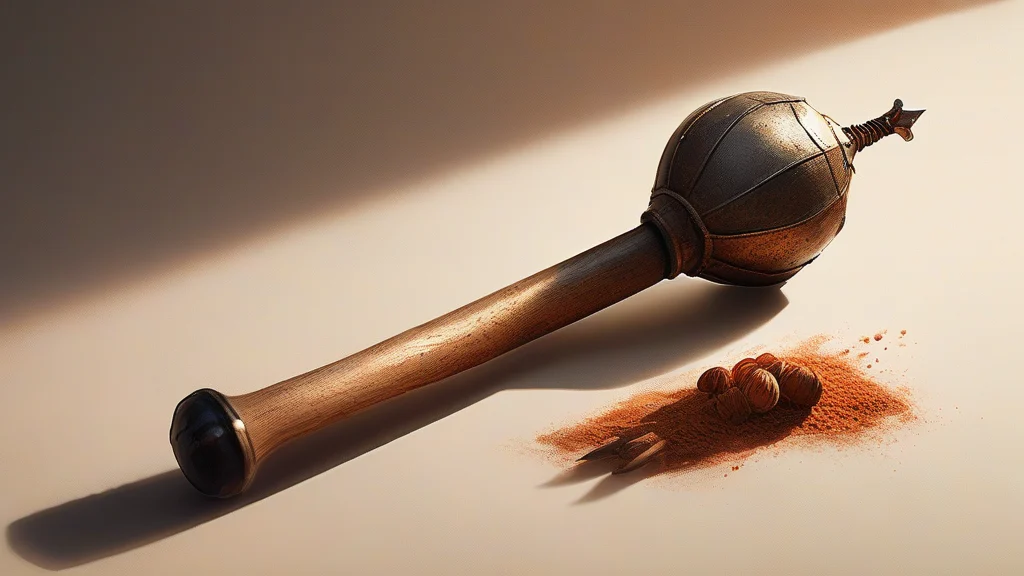
What does mace mean?
A mace is principally a heavy club or weapon, often with a flanged, spiked, or otherwise massive head. Historically, maces were used in warfare, especially during the medieval period, and they later became ceremonial symbols carried by officials and dignitaries. The word has a separate culinary meaning: mace is the bright reddish-orange, lacy membrane surrounding a nutmeg seed, dried and ground as a warm, aromatic spice with a slightly peppery flavor. In informal usage, especially in phrases such as 'a small mace,' the word can also mean money. These distinct senses make mace unusual among common English words, because the same three-syllable-free form names both an object of force and a delicate culinary ingredient. In a general context, the intended meaning usually depends on whether the surrounding discussion concerns history, ceremony, cooking, or informal speech.
A heavy club or blunt weapon with a heavy head, historically used in battle and later as a ceremonial symbol of authority.
"The ceremonial officer entered carrying a golden mace."
The historical and ceremonial senses are common in British and American English.
The dried, reddish-orange membrane surrounding a nutmeg seed, used as a spice.
"The recipe calls for mace, cinnamon, and a little nutmeg."
This culinary sense is especially associated with South Asian, Middle Eastern, and European cooking.
Informal slang for money, especially a large sum of money.
"The club charged a small mace for admission."
This sense is informal and more common in British and American slang.
The ordinary plural is used for multiple weapons or objects; the spice is generally used as an uncountable noun, though 'maces' can refer to individual pieces of the spice in specialized contexts.
"The guards carried maces as they marched through the courtyard."
A mace can mean both a formidable weapon and the fragrant, delicate membrane wrapped around a nutmeg.
Reviewed by Deb Chak, Editor. AI-assisted content curated by RJS Tech Solutions LLP.
Where does mace come from?
The weapon sense comes through Old French masse, a club or heavy weapon, from a Latin word associated with a mass or bulky object; English also developed related forms such as mass and massive through the same general Latin tradition. The culinary sense has a different origin: it comes from an Arabic term referring to the covering of the nutmeg seed, passed into English through medieval trade and Arabic-influenced culinary vocabulary. The two meanings therefore arrived in English through separate historical routes, although they are now fully established in modern usage.
How mace is actually used
The weapon and spice senses are standard in British and American English. The sense meaning money is informal and sometimes appears in the expression 'a small mace' for a small amount of money.