
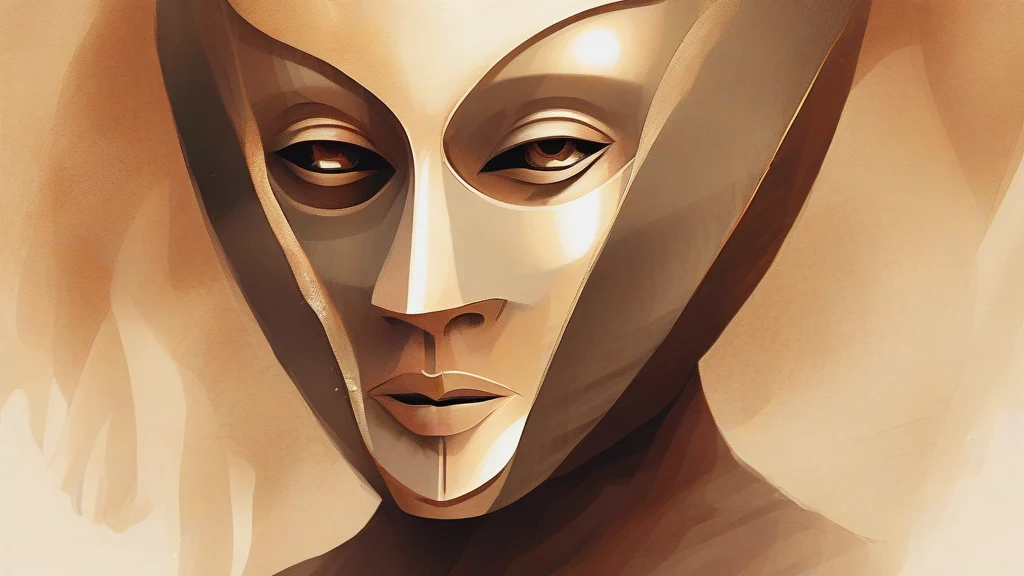
What does masklike mean?
Masklike describes something that resembles a mask, most often a face or expression that reveals little of the person’s feelings or intentions. The word suggests a fixed, controlled, or inscrutable appearance, as though the person is concealing what they think or feel behind an artificial exterior. It can be admiring when the composure appears disciplined and dignified, but more often it carries a faintly critical implication that the expression is unnaturally rigid or emotionally distant. In literary and psychological contexts, “masklike” can describe faces, figures, and even landscapes whose appearance conceals depth or meaning. The term is more precise than simply “blank” or “expressionless,” because it compares the person’s appearance to the deliberate obscuring function of a mask. It is also useful for writing about public demeanour, formal social interactions, and moments when someone seems impossible to interpret.
adjectiveResembling a mask, especially in having a fixed, expressionless, or inscrutable appearance.
- Resembling a mask in appearance, especially through a fixed, expressionless, or inscrutable look.
"Her masklike composure concealed any sign of uncertainty."
"The negotiations continued behind his masklike expression."
"The statue's masklike face gave no indication of what it might be thinking."
A masklike face withholds more than identity: it can make even an ordinary expression seem impossible to read.
Reviewed by Deb Chak, Editor. AI-assisted content curated by RJS Tech Solutions LLP.
Where does masklike come from?
The adjective was formed in English by combining “mask” with the suffix-like element meaning “resembling” or “similar to.” The noun “mask” came through French from Italian maschera and ultimately derives from Arabic maskhara, associated with masking or disguise. “Masquerade” belongs to the same broad etymological tradition of masking, disguise, and concealed identity.
How masklike is actually used
The word is usually written as one word, though the hyphenated form “mask-like” is also encountered. It is especially used of faces, expressions, and behaviour that appear deliberately controlled or emotionally unreadable.
Easily confused with masklike
Masklike means resembling or suggestive of a mask, whereas masked means covered or disguised by a mask.