
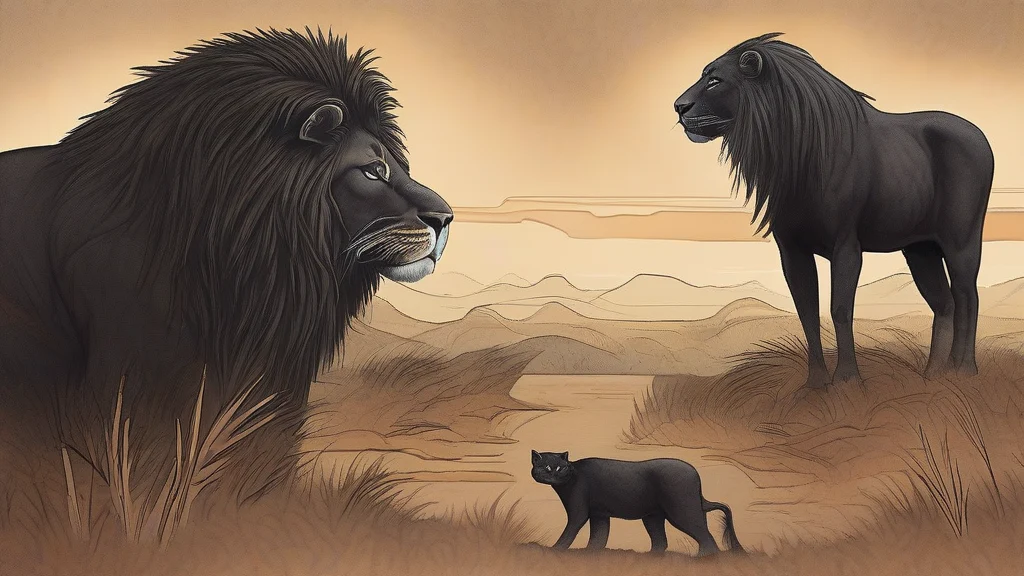
What does melanism mean?
Melanism is the biological condition of having an excessive amount of dark pigment. It is especially common as a term for animals whose skin, fur, feathers, or scales are unusually dark, and it may occur naturally or be favoured by natural selection. The best-known example is industrial melanism, in which dark peppered moths became more numerous in polluted areas because soot-darkened trees gave them better camouflage from predators. The term can also refer more broadly to the development or prevalence of darker coloration in a population. Melanism is distinct from ordinary variation in pigmentation: it specifically implies an unusually high degree of dark coloration. In evolutionary discussions, it is especially useful for showing how environmental change can alter the frequency of inherited traits over generations.
nounThe condition of having an excessive amount of dark pigmentation, especially in an animal or plant. In evolutionary biology, melanism refers to the development of darker coloration, often resulting from natural selection.
- The condition or state of having an excessive amount of dark pigmentation, especially in animals; also, the development or prevalence of darker coloration within a population.
"Industrial melanism helped dark moths become more common in polluted environments where their camouflage reduced predation."
"The species displays a rare form of melanism that makes its coat almost entirely black."
"Researchers studied the rise of melanism among moths living near heavily polluted industrial sites."
The plural is rare and is used when referring to distinct instances or forms of the condition.
"The guide describes several examples of melanisms found in island mammals."
Industrial melanism made peppered moths a famous example of evolution in action, as darker moths gained protection in soot-darkened environments.
Reviewed by Deb Chak, Editor. AI-assisted content curated by RJS Tech Solutions LLP.
Where does melanism come from?
Melanism was formed in the 19th century from the combining form melan-, derived from Greek melas, meaning “black,” together with the suffix -ism, indicating a condition or state. The same Greek root appears in melanin, melanocyte, and melanosis, all words concerned with dark pigment or pigment-producing tissues.
Related word forms
How melanism is actually used
The term is most common in biology, particularly zoology and evolutionary biology. It describes a condition or evolutionary pattern and is usually used when the pigmentation is unusually dark, rather than simply present.
Easily confused with melanism
Melanism is a condition involving increased dark pigmentation, whereas melanoma is a type of skin cancer that begins in pigment-producing cells.