
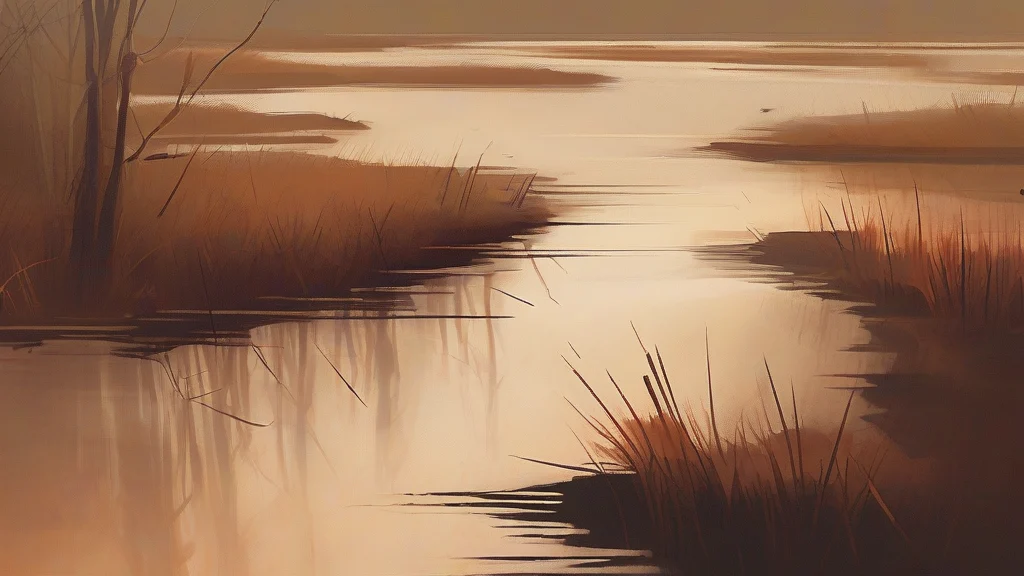
What does mire mean?
A mire is muddy, swampy ground, and the word is often used figuratively for a situation that is confusing, unpleasant, and difficult to escape from. Expressions such as “mired in debt” and “mired in controversy” portray people or institutions as so deeply entangled in a problem that progress has become almost impossible. As a verb, “to mire” describes becoming stuck in mud or causing something else to become stuck; “the wheels mired in the mud” is a familiar example. The figurative use is common in political, legal, and financial writing, where it emphasizes paralysis and entanglement rather than merely unpleasant conditions. Although “mire” belongs to ordinary English vocabulary, its elevated, literary tone distinguishes it from plainer words such as “mud” or “bog.” It remains especially effective when describing problems that seem to trap those involved.
An area of wet, muddy, or swampy ground; figuratively, a difficult situation from which it is hard to escape.
"The road became a mire after several days of torrential rain."
Figurative uses such as “the mire of confusion” are somewhat literary and convey a sense of being trapped.
To become stuck in mud, or to cause someone or something to become stuck; figuratively, to involve someone so deeply in difficulty that they cannot readily act.
"The heavy vehicle mired in the mud near the riverbank."
The figurative use is especially common in the passive construction “mired in” a problem or situation.
The noun is commonly used as an uncountable noun for muddy ground, but the plural can refer to separate patches of mud or swamp.
"Cattle wandered into the mires beside the road."
A mire began as literal mud that trapped wheels and feet; figuratively, it became shorthand for any situation that pulls people down and prevents easy escape.
Reviewed by Deb Chak, Editor. AI-assisted content curated by RJS Tech Solutions LLP.
Where does mire come from?
The word comes from Old English, where forms of “mire” referred to wet, muddy, or swampy ground. It developed through Middle English and is related to “mud” and “muddy,” which preserve the same basic sense of wet earth. The verb developed from the noun’s older associations with boggy ground and eventually acquired figurative meanings involving being trapped or deeply entangled in difficulty.
Related word forms
How mire is actually used
The noun is standard but somewhat literary, especially in figurative uses. The verb occurs chiefly in the passive, as in “mired in debt,” and can also be used intransitively for a vehicle or person becoming stuck in mud.
Easily confused with mire
The noun mire names muddy or swampy ground, while the verb mire describes becoming stuck in mud or becoming deeply entangled in difficulty.