
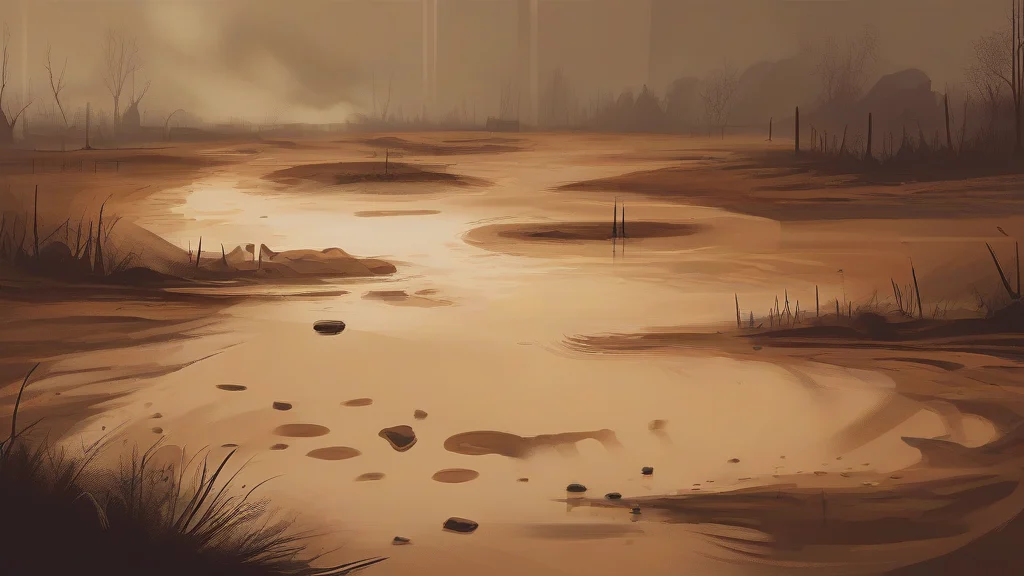
What does mud mean?
Mud is the soft, wet mixture of soil and water that forms after rain, in riverbanks, on muddy paths, and wherever ground is churned into a slick paste. The word is useful because it can describe both a familiar physical substance and a range of figurative problems. To be "in the mud" means to be in financial trouble or disgrace, while "mud-slinging" means making insulting accusations. The noun is generally neutral in tone, though descriptions of mud can convey messiness, difficulty, or rural or seasonal conditions. As a verb, mud refers to covering or staining something with mud, as when boots become mudded. Its vivid concrete meaning gives it a strong place in descriptions of weather, travel, construction, farming, and landscapes.
Wet, soft earth, especially a muddy mixture formed by rain or disturbed ground.
"The low ground turned to mud after several days of rain."
The noun is common in literal descriptions of weather, roads, fields, and construction sites. Figuratively, it can mean a compromising or embarrassing situation.
To cover, smear, or fill with mud.
"The boots were mudded before the children reached the farmhouse."
The verb is relatively uncommon and is more typical of descriptive writing than of formal speech.
The plural muds is uncommon; mud is normally used as an uncountable noun.
"The guide described several local muds and their differing textures."
Mud is the great equalizer: it turns clean shoes dirty, ruins engines, and has launched countless complaints about the state of the roads.
Reviewed by Deb Chak, Editor. AI-assisted content curated by RJS Tech Solutions LLP.
Where does mud come from?
The English word descends from Middle English mudde, a form recorded in medieval English, and probably from Old English mudde. Its ultimate origin is uncertain, and proposed connections with words in other languages for wet earth or mire remain debated. The modern word has continued to serve both its literal meaning for wet soil and its extended figurative meanings for dirty or troubled circumstances.
Related word forms
How mud is actually used
Mud is neutral in register for the literal material, but figurative uses such as "in the mud" and "mud-slinging" can imply scandal, blame, or financial difficulty. The verb is less common than the noun and often sounds informal or descriptive.
Easily confused with mud
Mud is wet earth or a figurative mess, whereas a muddle is a confused state or a failure to organize something clearly.